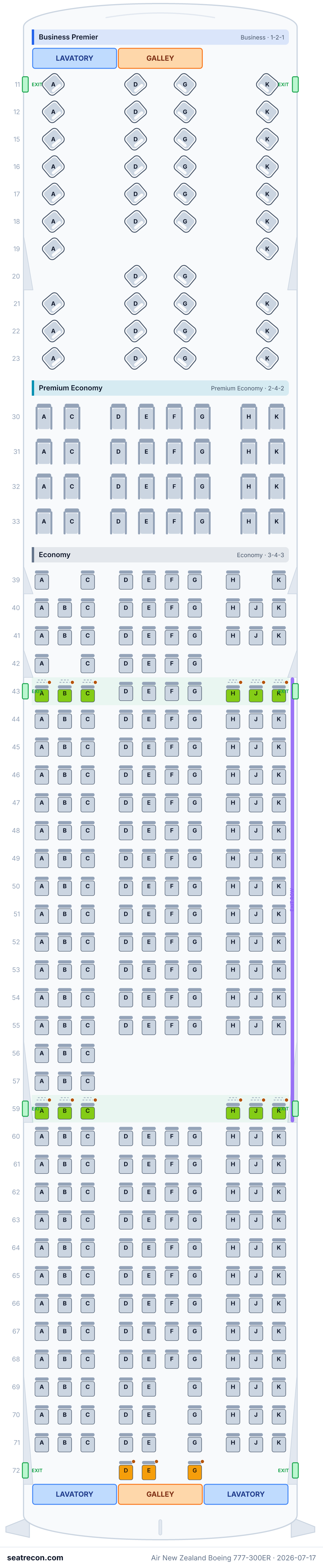
Air New Zealand Boeing 777-300ER — rozkład miejsc — 368 foteli
Mapa miejsc
Najedź na dowolny fotel lub go dotknij, aby zobaczyć ocenę i szczegóły.
Dotknij fotela lub najedź na niego, aby zobaczyć ocenę i szczegóły. Na telefonie: rozsuń palce, aby przybliżyć, i przeciągnij, aby przesunąć.
- — Last-row seat immediately ahead of the rear service area — light, noise and foot traffic are possible.
- Rzędy przy wyjściach awaryjnych: 43 i 59
Dotknij numeru miejsca, aby zobaczyć je na mapie.
Jak oceniamy miejsca →Najlepsze i najgorsze miejsca
Typy naszego silnika ocen dla tego układu kabiny — pełne uzasadnienie każdego fotela znajdziesz na mapie powyżej.
Warto wiedzieć
- 72D, 72E, 72G — Last-row seat immediately ahead of the rear service area — light, noise and foot traffic are possible.
Przewodnik po miejscach
Wskazówki kabina po kabinie, wygenerowane ze zweryfikowanych danych układu tej mapy: które miejsca wyróżniają się w ocenach, nad którymi warto się zastanowić i które rzędy warto znać przed wyborem.
Business Premier
Oceny w tej kabinie są wyrównane — w naszych danych nie ma miejsc wyróżniających się ani problematycznych.
Premium Economy
Oceny w tej kabinie są wyrównane — w naszych danych nie ma miejsc wyróżniających się ani problematycznych.
Economy
Miejsca, których lepiej unikać
- 72D, 72E, 72G — Last-row seat immediately ahead of the rear service area — light, noise and foot traffic are possible.
- Rzędy przy wyjściach awaryjnych: 43 i 59
- Rzędy przy kuchni pokładowej: 72
Najczęstsze pytania
- Ile miejsc ma Boeing 777-300ER linii Air New Zealand?
- Ta konfiguracja ma 368 miejsc: 40 Business Premier, 32 Premium Economy, 296 Economy.
- Które miejsca w Boeing 777-300ER linii Air New Zealand są najlepsze?
- Dostępne dowody nie wskazują wyróżniającego się fotela w tym układzie. Nierozstrzygnięte szczegóły komfortu pozostają niezweryfikowane.
- Których miejsc unikać?
- Oznaczone w naszych danych: 72D, 72E, 72G — Last-row seat immediately ahead of the rear service area — light, noise and foot traffic are possible.
- Które rzędy są przy wyjściach awaryjnych?
- Rzędy 43 i 59 to rzędy przy wyjściach awaryjnych.
- Czy Boeing 777-300ER linii Air New Zealand ma miejsca rozkładane na płasko (lie-flat)?
- Tak — kabina Business Premier oferuje miejsca rozkładane do w pełni płaskiego łóżka (40).
Kabiny
Business Premier
- Fotel
- Fotel rozkładany na płasko
Premium Economy
- Rozstaw
- 39.5"publikowane
- Fotel
- Fotel z odchylanym oparciem
39-40 in pitch published by Air New Zealand for this leased layout.
Economy
- Rozstaw
- 31.5"publikowane
- Fotel
- Fotel standardowy
31-32 in pitch published by Air New Zealand for this leased layout.
Wyposażenie pokładu
Naniesione na interaktywną mapę powyżej — najedź na dany element, aby potwierdzić jego położenie.
10 toalet · 2 kuchnie · 5 par drzwi
Grafika mapy miejsc
Gotowy do wydruku obraz dokładnie tego układu — zapisz go na dzień podróży. Źródłem prawdy pozostaje interaktywna mapa powyżej.
Źródła
Każdy wymiar i każda informacja na tej stronie prowadzi do jednego z poniższych źródeł. Ostatnia weryfikacja: 17 lip 2026.
Cytaty ze źródeł i notatki badawcze poniżej pozostawiamy po angielsku — w języku, w którym zostały zweryfikowane.
- Air New ZealandŹRÓDŁO PIERWOTNEPobrano 17 lip 2026
Current official 368-seat Boeing 777-367ER V2 page: 40 Business Premier, 32 Premium Economy and 296 Economy, with published cabin row ranges and pitch.
The page uses a separate static map image for the exact row grid.
https://www.airnewzealand.com/seat-map-boeing-777-367-v2 ↗ - Air New ZealandŹRÓDŁO PIERWOTNEPobrano 17 lip 2026
Official OKV static map: exact row/seat identifiers, cabin geometry, monuments, bassinets and highlighted exit-row seats.
Schematic does not prove real window-to-seat alignment.
https://p-airnz.com/cms/assets/Common-Assets/Dry-Lease/J017969-OKV-Seatmap__ScaleMaxWidthWzIwODBd.jpg ↗ - Air New ZealandŹRÓDŁO PIERWOTNEPobrano 17 lip 2026
Official legend identifies Business Premier, Premium Economy, standard, Exit Row and bassinet symbols.
https://p-airnz.com/cms/assets/Common-Assets/Dry-Lease/OKV-Seat-choices-V2__ScaleMaxWidthWzIwODBd.png ↗ - Air New ZealandŹRÓDŁO PIERWOTNEPobrano 17 lip 2026
Air New Zealand interim fleet table at 31 December 2025: three short-term leased 777-300ERs in addition to seven core aircraft.
The filing does not split the three leases between the 294- and 368-seat maps.
https://p-airnz.com/cms/assets/PDFs/air-nz-2026-interim-results-presentation.pdf ↗ - Air New ZealandŹRÓDŁO PIERWOTNEPobrano 1 paź 2026
Configuration-specific published cabin counts, numbered positions, and explicitly stated seat-level products, measurements and amenities.
Only explicit numbered DOM entries establish every printed row/letter. Static maps use repeated column labels and numbered drawn positions; they do not print every seat letter. Window alignment, manufacturer hardware and exact operating-tail assignments are not established by these diagrams.
https://www.airnewzealand.com/seat-map-boeing-777-367-v2 ↗ - Air New ZealandŹRÓDŁO PIERWOTNEPobrano 1 paź 2026
2026 annual results slides 8 and38: nine of fourteen existing 787 retrofits complete; remaining planned by November 2026; dated 30 June 2026 separate brand subfleet counts. Slide 7 documents changing short-term lease fleet.
Counts are dated, not a live 1 October 2026 tail census. 9/14 is programme completion at presentation time; no exact current old 275/302 split or retired 777 tail is specified.
https://p-airnz.com/customer-website-ui/media/airnz-2026-annual-results-investor-presentation.pdf ↗ - Air New ZealandŹRÓDŁO PIERWOTNEPobrano 1 paź 2026
Static numbered drawn seat positions and repeated column headers; visually reconciled with frozen baseline.
No physical window alignment, regulatory exitType or measured proximity established.
https://p-airnz.com/cms/assets/Common-Assets/Dry-Lease/J017969-OKV-Seatmap__ScaleMaxWidthWzIwODBd.jpg ↗
Air New Zealand’s current Boeing 777-367ER V2 page and official OKV map are transcribed row-for-row: 40 Business Premier, 32 Premium Economy and 296 Economy. The map’s legend identifies the12 outboard seats at rows43 and59 as Exit Row; they remain standard Y within the published296-seat Economy cabin because no extra-space claim is bound to these positions. No Skycouch product is shown on the bound OKV page, map or legend. Air New Zealand’s February 2026 fleet table reports three short-term leased 777-300ERs across this and the 294-seat layout, without a per-layout split, so no fleetCount is asserted. Monument and bassinet placement is simplified while the seat grid is a direct published-map transcription. No 777 window grid is bound and every window-position alignment remains unknown. AUDIT 2026-10-01: Current configuration-specific numbered map and explicit seat disclosures reviewed. Complete current tail, window and monument audit remains partial; see docs/audit-australia-new-zealand-2026-10-01/NZ.json. Historical full verification date retained. Exit designation and restrictions are retained; no canonical extra-legroom tier or positive rating is inferred solely from an Exit Row label.
Co się zmieniło
- 3 paź 2026Removed unproven premium fee tier from the Exit Row zone; all positions, counts, dimensions, ratings, restrictions, dates and earlier history preserved.
- 3 paź 2026After actual exact-file review, corrected source-specific seat disclosures, assigned-type claims and schematic source anchors where supported; retained every numbered seat position, published exit restrictions, verification dates and earlier history. Exit Row alone no longer implies extra legroom or a positive rating in the scoped unproven configurations.
- 3 paź 2026Applied independently scoped source corrections: added 2 explicit native-map monuments as derived schematic anchors; no measured distance, exact bassinet host seat or whole-row restriction inferred. Preserved historical verification date and prior changelog. Root source-versus-render inspection and final actual model review remain required.
- 1 paź 2026Australia/New Zealand primary audit: rechecked current official map; Removed unsourced regulatory exitType classifications; door positions retained as diagram anchors. Complete configuration verification remains partial.
- 17 lip 2026Initial 777-367ER V2 published-map transcription.