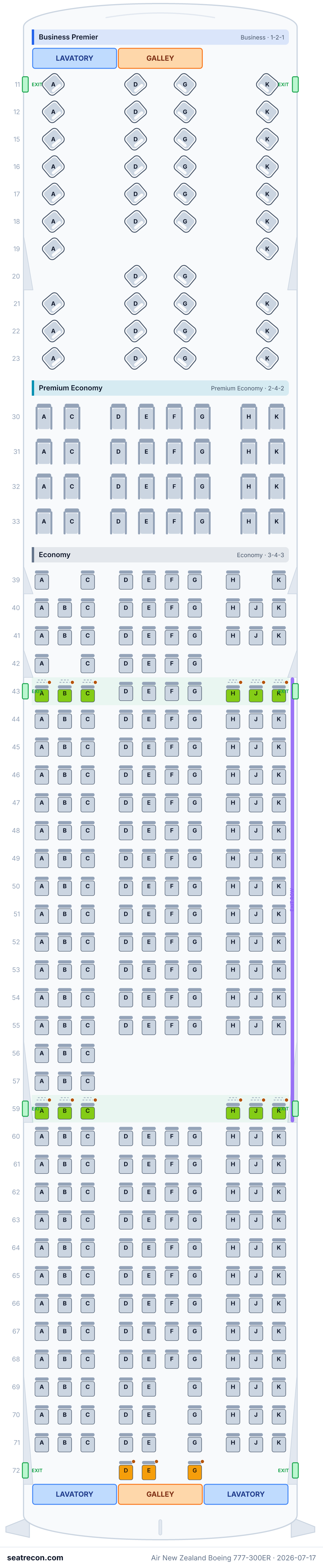
Mapa de asientos del Boeing 777-300ER de Air New Zealand — 368 asientos
Mapa de asientos
Pasa el cursor o toca cualquier asiento para ver su valoración y detalles.
Toca o pasa el cursor sobre un asiento para ver su valoración y detalles. En el teléfono, pellizca para hacer zoom y arrastra para desplazarte.
- — Last-row seat immediately ahead of the rear service area — light, noise and foot traffic are possible.
- Filas de salida de emergencia: 43 y 59
Toca un número de asiento para verlo en el mapa.
Cómo valoramos los asientos →Mejores y peores asientos
Las selecciones de nuestro motor de valoración para esta distribución — consulta el razonamiento completo de cualquier asiento en el mapa de arriba.
Conviene saber
- 72D, 72E, 72G — Last-row seat immediately ahead of the rear service area — light, noise and foot traffic are possible.
Guía de asientos
Orientación cabina por cabina generada a partir de los registros verificados de esta configuración: qué asientos destacan en las valoraciones, cuáles conviene pensarse dos veces y qué filas conviene conocer antes de elegir.
Business Premier
Las valoraciones son uniformes en esta cabina — sin asientos destacados ni problemáticos en nuestros registros.
Premium Economy
Las valoraciones son uniformes en esta cabina — sin asientos destacados ni problemáticos en nuestros registros.
Economy
Asientos a evitar
- 72D, 72E, 72G — Last-row seat immediately ahead of the rear service area — light, noise and foot traffic are possible.
- Filas de salida de emergencia: 43 y 59
- Filas junto a la cocina de a bordo: 72
Preguntas frecuentes
- ¿Cuántos asientos tiene el Boeing 777-300ER de Air New Zealand?
- Esta configuración tiene 368 asientos: 40 Business Premier, 32 Premium Economy, 296 Economy.
- ¿Cuáles son los mejores asientos del Boeing 777-300ER de Air New Zealand?
- Las pruebas disponibles no permiten destacar ningún asiento en esta configuración. Los detalles de comodidad sin resolver siguen sin verificar.
- ¿Qué asientos debería evitar?
- Señalados en nuestros datos: 72D, 72E, 72G — Last-row seat immediately ahead of the rear service area — light, noise and foot traffic are possible.
- ¿Qué filas son salidas de emergencia?
- Las filas 43 y 59 son filas de salida de emergencia.
- ¿Tiene el Boeing 777-300ER de Air New Zealand asientos cama (lie-flat)?
- Sí — Business Premier tiene 40 asientos que se convierten en cama totalmente plana.
Cabinas
Business Premier
- Asiento
- Asiento cama plano
Premium Economy
- Pitch
- 39.5"publicado
- Asiento
- Butaca reclinable
39-40 in pitch published by Air New Zealand for this leased layout.
Economy
- Pitch
- 31.5"publicado
- Asiento
- Asiento estándar
31-32 in pitch published by Air New Zealand for this leased layout.
Instalaciones a bordo
Dibujadas en el mapa interactivo de arriba — pasa el cursor sobre un elemento para confirmar su posición.
10 baños · 2 cocinas · 5 pares de puertas
Imagen del mapa de asientos
Una captura imprimible de esta misma distribución — guárdala para consultarla el día del vuelo. El mapa interactivo de arriba sigue siendo la referencia definitiva.
Fuentes
Cada medida y afirmación de esta página se remonta a una de estas fuentes. Última verificación: 17 jul 2026.
Los extractos de las fuentes y las notas de investigación que siguen se citan en inglés, el idioma en el que fueron verificados.
- Air New ZealandFUENTE PRIMARIAConsultado el 17 jul 2026
Current official 368-seat Boeing 777-367ER V2 page: 40 Business Premier, 32 Premium Economy and 296 Economy, with published cabin row ranges and pitch.
The page uses a separate static map image for the exact row grid.
https://www.airnewzealand.com/seat-map-boeing-777-367-v2 ↗ - Air New ZealandFUENTE PRIMARIAConsultado el 17 jul 2026
Official OKV static map: exact row/seat identifiers, cabin geometry, monuments, bassinets and highlighted exit-row seats.
Schematic does not prove real window-to-seat alignment.
https://p-airnz.com/cms/assets/Common-Assets/Dry-Lease/J017969-OKV-Seatmap__ScaleMaxWidthWzIwODBd.jpg ↗ - Air New ZealandFUENTE PRIMARIAConsultado el 17 jul 2026
Official legend identifies Business Premier, Premium Economy, standard, Exit Row and bassinet symbols.
https://p-airnz.com/cms/assets/Common-Assets/Dry-Lease/OKV-Seat-choices-V2__ScaleMaxWidthWzIwODBd.png ↗ - Air New ZealandFUENTE PRIMARIAConsultado el 17 jul 2026
Air New Zealand interim fleet table at 31 December 2025: three short-term leased 777-300ERs in addition to seven core aircraft.
The filing does not split the three leases between the 294- and 368-seat maps.
https://p-airnz.com/cms/assets/PDFs/air-nz-2026-interim-results-presentation.pdf ↗ - Air New ZealandFUENTE PRIMARIAConsultado el 1 oct 2026
Configuration-specific published cabin counts, numbered positions, and explicitly stated seat-level products, measurements and amenities.
Only explicit numbered DOM entries establish every printed row/letter. Static maps use repeated column labels and numbered drawn positions; they do not print every seat letter. Window alignment, manufacturer hardware and exact operating-tail assignments are not established by these diagrams.
https://www.airnewzealand.com/seat-map-boeing-777-367-v2 ↗ - Air New ZealandFUENTE PRIMARIAConsultado el 1 oct 2026
2026 annual results slides 8 and38: nine of fourteen existing 787 retrofits complete; remaining planned by November 2026; dated 30 June 2026 separate brand subfleet counts. Slide 7 documents changing short-term lease fleet.
Counts are dated, not a live 1 October 2026 tail census. 9/14 is programme completion at presentation time; no exact current old 275/302 split or retired 777 tail is specified.
https://p-airnz.com/customer-website-ui/media/airnz-2026-annual-results-investor-presentation.pdf ↗ - Air New ZealandFUENTE PRIMARIAConsultado el 1 oct 2026
Static numbered drawn seat positions and repeated column headers; visually reconciled with frozen baseline.
No physical window alignment, regulatory exitType or measured proximity established.
https://p-airnz.com/cms/assets/Common-Assets/Dry-Lease/J017969-OKV-Seatmap__ScaleMaxWidthWzIwODBd.jpg ↗
Air New Zealand’s current Boeing 777-367ER V2 page and official OKV map are transcribed row-for-row: 40 Business Premier, 32 Premium Economy and 296 Economy. The map’s legend identifies the12 outboard seats at rows43 and59 as Exit Row; they remain standard Y within the published296-seat Economy cabin because no extra-space claim is bound to these positions. No Skycouch product is shown on the bound OKV page, map or legend. Air New Zealand’s February 2026 fleet table reports three short-term leased 777-300ERs across this and the 294-seat layout, without a per-layout split, so no fleetCount is asserted. Monument and bassinet placement is simplified while the seat grid is a direct published-map transcription. No 777 window grid is bound and every window-position alignment remains unknown. AUDIT 2026-10-01: Current configuration-specific numbered map and explicit seat disclosures reviewed. Complete current tail, window and monument audit remains partial; see docs/audit-australia-new-zealand-2026-10-01/NZ.json. Historical full verification date retained. Exit designation and restrictions are retained; no canonical extra-legroom tier or positive rating is inferred solely from an Exit Row label.
Qué cambió
- 3 oct 2026Removed unproven premium fee tier from the Exit Row zone; all positions, counts, dimensions, ratings, restrictions, dates and earlier history preserved.
- 3 oct 2026After actual exact-file review, corrected source-specific seat disclosures, assigned-type claims and schematic source anchors where supported; retained every numbered seat position, published exit restrictions, verification dates and earlier history. Exit Row alone no longer implies extra legroom or a positive rating in the scoped unproven configurations.
- 3 oct 2026Applied independently scoped source corrections: added 2 explicit native-map monuments as derived schematic anchors; no measured distance, exact bassinet host seat or whole-row restriction inferred. Preserved historical verification date and prior changelog. Root source-versus-render inspection and final actual model review remain required.
- 1 oct 2026Australia/New Zealand primary audit: rechecked current official map; Removed unsourced regulatory exitType classifications; door positions retained as diagram anchors. Complete configuration verification remains partial.
- 17 jul 2026Initial 777-367ER V2 published-map transcription.