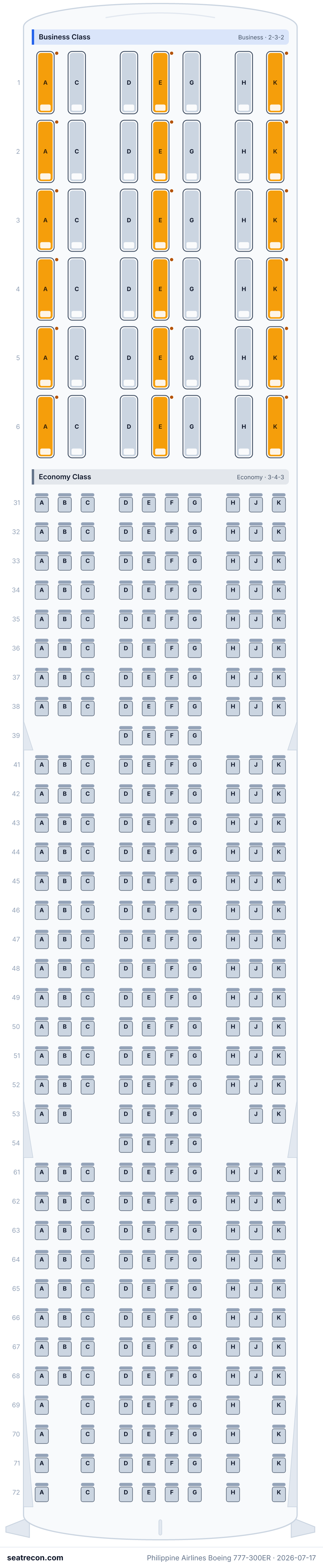
Philippine Airlines Boeing 777-300ER — rozkład miejsc — 370 foteli
Ocena foteli
Oceny sprawdzono na podstawie podanych źródeł. Szczegóły bez wystarczających dowodów, w tym nieznane ustawienie okien, pozostają niezweryfikowane.
Mapa miejsc
Najedź na dowolny fotel lub go dotknij, aby zobaczyć ocenę i szczegóły.
Dotknij fotela lub najedź na niego, aby zobaczyć ocenę i szczegóły. Na telefonie: rozsuń palce, aby przybliżyć, i przeciągnij, aby przesunąć.
- — Business window or centre-middle seat: reaching the aisle passes a neighbour in the exact published 2-3-2 grid.
- Rzędy z mocowaniem gondoli (bassinet): 1, 5, 31 i 61
Dotknij numeru miejsca, aby zobaczyć je na mapie.
Jak oceniamy miejsca →Najlepsze i najgorsze miejsca
Typy naszego silnika ocen dla tego układu kabiny — pełne uzasadnienie każdego fotela znajdziesz na mapie powyżej.
Warto wiedzieć
- 1A, 1E, 1K, 2A, 2E, 2K — Business window or centre-middle seat: reaching the aisle passes a neighbour in the exact published 2-3-2 grid.
Przewodnik po miejscach
Wskazówki kabina po kabinie, wygenerowane ze zweryfikowanych danych układu tej mapy: które miejsca wyróżniają się w ocenach, nad którymi warto się zastanowić i które rzędy warto znać przed wyborem.
Business Class
Miejsca, których lepiej unikać
- 1A, 1E, 1K, 2A, 2E, 2K, 3A, 3E, 3K, 4A, 4E, 4K — Business window or centre-middle seat: reaching the aisle passes a neighbour in the exact published 2-3-2 grid.
- Rzędy z mocowaniem gondoli (bassinet): 1 i 5
- Rzędy przy kuchni pokładowej: 1, 4 i 5
- Rzędy przy toalecie: 5
Economy Class
Miejsca, których lepiej unikać
- 38A, 38B, 38C, 38H, 38J, 38K — Nearest populated block to the outer lavatory bank after row 38 shown in the native schematic; possible lavatory use noise or nearby queueing are unmeasured editorial cautions. Correlated service effects count as one caution.
- 39D, 39E, 39F, 39G — Nearest populated block to the two distinct central lavatories after row 39 shown in the native schematic; possible lavatory use noise or nearby queueing are unmeasured editorial cautions. Correlated service effects count as one caution.
- 41A, 41B — Nearest populated block to the outer lavatories after row 38 and central lavatory pair after row 39 shown in the native schematic; possible lavatory use noise or nearby queueing are unmeasured editorial cautions. Correlated service effects count as one caution.
- Rzędy z mocowaniem gondoli (bassinet): 31 i 61
- Rzędy przy kuchni pokładowej: 54, 61 i 72
- Rzędy przy toalecie: 38, 39, 41 i 53
Najczęstsze pytania
- Ile miejsc ma Boeing 777-300ER linii Philippine Airlines?
- Ta konfiguracja ma 370 miejsc: 42 Business Class, 328 Economy Class.
- Które miejsca w Boeing 777-300ER linii Philippine Airlines są najlepsze?
- Dostępne dowody nie wskazują wyróżniającego się fotela w tym układzie. Nierozstrzygnięte szczegóły komfortu pozostają niezweryfikowane.
- Których miejsc unikać?
- Oznaczone w naszych danych: 1A, 1E, 1K, 2A, 2E, 2K, 3A, 3E — Business window or centre-middle seat: reaching the aisle passes a neighbour in the exact published 2-3-2 grid.
- W których rzędach są mocowania gondoli?
- Mocowania gondoli obsługują rzędy 1, 5, 31 i 61.
- Czy Boeing 777-300ER linii Philippine Airlines ma miejsca rozkładane na płasko (lie-flat)?
- Tak — kabina Business Class oferuje miejsca rozkładane do w pełni płaskiego łóżka (42).
Kabiny
Business Class
- Rozstaw
- 78"publikowane
- Szerokość
- 20.4"publikowane
- Fotel
- Fotel rozkładany na płasko
- Ekran
- Ekran zamontowany (rozmiar nieopublikowany)
- Zasilanie
- Gniazdko AC · USB-A
W tej kabinie: Wi-Fi dostępne · Zasilanie: Gniazdko AC, USB-A · Rozrywka: seatback
Economy Class
- Rozstaw
- 33"publikowane
- Szerokość
- 18.4"publikowane
- Fotel
- Fotel standardowy
- Ekran
- Ekran zamontowany (rozmiar nieopublikowany)
- Zasilanie
- USB-A
W tej kabinie: Wi-Fi dostępne · Zasilanie: USB-A · Rozrywka: seatback
Wyposażenie pokładu
Naniesione na interaktywną mapę powyżej — najedź na dany element, aby potwierdzić jego położenie.
11 toalet · 10 kuchni · 4 pary drzwi
Udogodnienia
Grafika mapy miejsc
Gotowy do wydruku obraz dokładnie tego układu — zapisz go na dzień podróży. Źródłem prawdy pozostaje interaktywna mapa powyżej.
Źródła
Każdy wymiar i każda informacja na tej stronie prowadzi do jednego z poniższych źródeł. Ostatnia weryfikacja: 6 paź 2026.
Cytaty ze źródeł i notatki badawcze poniżej pozostawiamy po angielsku — w języku, w którym zostały zweryfikowane.
- Philippine AirlinesŹRÓDŁO PIERWOTNEPobrano 17 lip 2026
Historical fleet-index record lists the 370-seat Boeing 777-300ER product; current cabin split and specifications are sourced to the separately cited accommodation model.
Retained July source snapshot and retrieval date. The previous attribution of the 42/328 cabin split to the fleet index is superseded; the current accommodation model supports those counts.
https://www.philippineairlines.com/ph/en/inflight-experience/airfleet.html ↗ - WikipediaŹRÓDŁO NIEZALEŻNEPobrano 17 lip 2026
As-of-2026 Philippine Airlines fleet table independently corroborates the in-service 370-seat Boeing 777-300ER (42 Business / 328 Economy), its cabin split and its total.
Neutral fleet-table cross-check; PAL's own current accommodation pages remain authoritative for hardware dimensions, and PAL's Comfort advisory defines that branded domestic product.
https://en.wikipedia.org/wiki/Philippine_Airlines_fleet ↗ - Philippine AirlinesŹRÓDŁO PIERWOTNEPobrano 17 lip 2026
Current operating-fleet page publishes 42 Business and 328 Economy seats, 2-3-2 and 3-4-3 layouts, pitch, width, recline, IFE, power and Wi-Fi availability.
The live HTML is an application shell; the snapshot is the official AEM page-model JSON containing the rendered accommodation table and asset references.
https://www.philippineairlines.com/ph/en/inflight-experience/airfleet/airfleet-plane-list/pal-operating-fleet/boeing-777-300er-370-seater.html ↗ - Philippine AirlinesŹRÓDŁO PIERWOTNEPobrano 17 lip 2026
Official 370-seat 777-300ER raster supplies row-number blocks, seat letters, cabin breaks, facilities and taper geometry.
Retained July native-image source record. Its former count-reconciliation interpretation is superseded by the October 6 exact native seat transcription. Current rows and columns are not selected or omitted to fit a specification total.
https://www.philippineairlines.com/content/dam/palportal/migration/files/airfleet-360/b777-300er-370-seater/seat-map-2.png ↗ - Philippine AirlinesŹRÓDŁO PIERWOTNEPobrano 6 paź 2026
Current official fleet-index model lists aircraft products and links to their accommodation pages. Named seater labels support product listing; cabin accommodation tables and seat-type specifications are supplied by the separate product models.
Fleet listing supports the offered aircraft product only; cabin counts, dimensions and amenities are sourced to the separate accommodation model, and exact seats to the native chart.
https://www.philippineairlines.com/ph/en/inflight-experience/airfleet.model.json ↗ - Philippine AirlinesŹRÓDŁO PIERWOTNEPobrano 6 paź 2026
Current official accommodation model publishes cabin counts, seat-type specifications and product amenities; it does not establish exact window alignment.
Native schematic is not measured geometry; engineering alignment disabled. Selection designations do not determine comfort ratings.
https://www.philippineairlines.com/ph/en/inflight-experience/airfleet/airfleet-plane-list/pal-operating-fleet/boeing-777-300er-370-seater.model.json ↗ - Philippine AirlinesŹRÓDŁO PIERWOTNEPobrano 6 paź 2026
Current official native numbered seat diagram and categorical selection legend.
Native schematic is not measured geometry; engineering alignment disabled. Selection designations do not determine comfort ratings.
https://www.philippineairlines.com/content/dam/palportal/migration/files/airfleet-360/b777-300er-370-seater/seat-map-2.png ↗
Current numbered diagram: 42 Business and 328 Economy seats, with Business ACDEFHK and Economy 3-4-3 grids. Historical configuration ID and URL are retained; Business 1G-6G are corrected to the native letters 1F-6F. Furniture comprises 10 distinct galley compartments, 11 lavatories and 4 source-drawn bilateral EXIT bands. Banks and EXIT-relative order are categorical schematic readings, not measured geometry. Proximity caps are not applied to banks wholly across a drawn EXIT axis; a source footprint overlapping the axis toward the nearest chair block may support one qualified caution. Service activity remains unmeasured and a baseline rating does not promise quiet. The native diagram draws no galley or lavatory at 6/31. The centre galley aft of Door 3 is nearest 61D/E/F/G; the centre galley fore of Door 4 is nearest 72D/E/F/G. Row 41 is nearest the drawn lavatory bank after rows 38 and 39; possible undrawn separators remain unverified. Historical July source interpretations are superseded by the current exact native transcription and accommodation tables. Physical exit markers follow explicit native EXIT arrows only. Other exit positions are unverified, not claimed absent. Exact Exit Row, bassinet, wheelchair, minor and nut-allergy designations are disclosed per seat and do not establish comfort advantages or restrictions on other passengers. Wall geometry, per-seat armrests, trays, storage and recline exceptions remain unverified. No engineering window grid is bound; all outboard alignments remain unknown.
Co się zmieniło
- 6 paź 2026Compared with the July 17 baseline, 1D, 1F, 4D, 4F, 5C, 5D, 5F, 5H, 38A, 38B, 38C, 38H, 38J, 38K, 39D, 39E, 39F, 39G, 41A, 41B, 41C, 41D, 41E, 41F, 41G, 41H, 41J, 41K, 53A, 53B, 53J, 53K, 54D, 54E, 54F, 54G, 61D, 61E, 61F, 61G, 72D, 72E, 72F, 72G move from Standard to Be Aware for qualified nearest-bank service cautions. No seat is upgraded. Ratings change from 18 Be Aware / 352 Standard to 62 Be Aware / 308 Standard. Corrected Business 1G-6G to the source letters 1F-6F; Economy identities and the historical configuration ID and URL are retained. Individually transcribed 10 galley compartments, 11 lavatories and 4 source-drawn bilateral EXIT bands with categorical bank order. Added exact selection-designation notes to 178 seats without changing comfort tiers for eligibility alone. Updated source attribution and per-seat reasons. Unsupported bulkhead wall attributes are not retained. Outboard window alignment remains unknown; unsupported engineering-window binding is not used.
- 17 lip 2026Initial Philippine Airlines 370-seat widebody configuration.