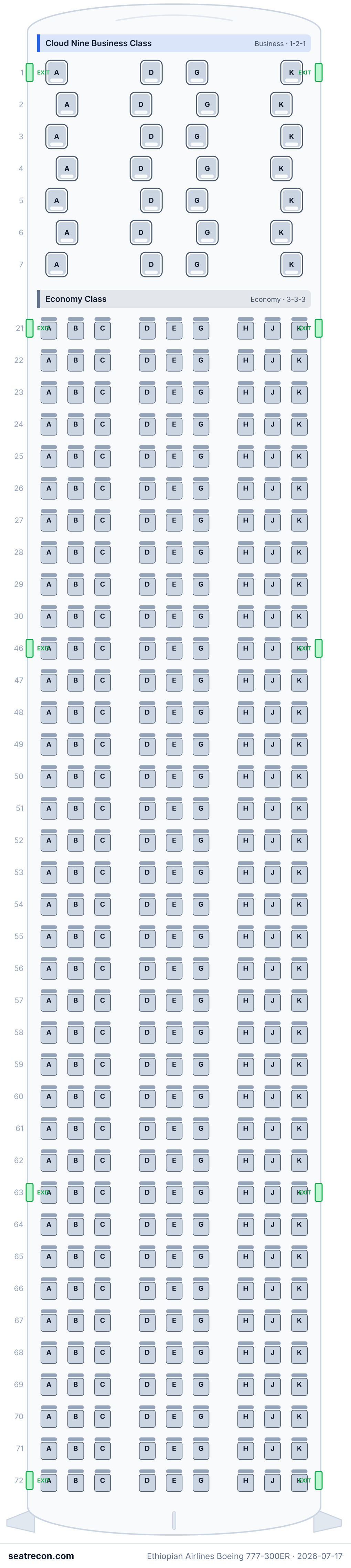
Ethiopian Airlines Boeing 777-300ER — rozkład miejsc — 361 foteli
Mapa miejsc
Najedź na dowolny fotel lub go dotknij, aby zobaczyć ocenę i szczegóły.
Dotknij fotela lub najedź na niego, aby zobaczyć ocenę i szczegóły. Na telefonie: rozsuń palce, aby przybliżyć, i przeciągnij, aby przesunąć.
Dotknij numeru miejsca, aby zobaczyć je na mapie.
Jak oceniamy miejsca →Przewodnik po miejscach
Wskazówki kabina po kabinie, wygenerowane ze zweryfikowanych danych układu tej mapy: które miejsca wyróżniają się w ocenach, nad którymi warto się zastanowić i które rzędy warto znać przed wyborem.
Cloud Nine Business Class
Oceny w tej kabinie są wyrównane — w naszych danych nie ma miejsc wyróżniających się ani problematycznych.
Economy Class
Oceny w tej kabinie są wyrównane — w naszych danych nie ma miejsc wyróżniających się ani problematycznych.
Najczęstsze pytania
- Ile miejsc ma Boeing 777-300ER linii Ethiopian Airlines?
- Ta konfiguracja ma 361 miejsc: 28 Cloud Nine Business Class, 333 Economy Class.
- Które miejsca w Boeing 777-300ER linii Ethiopian Airlines są najlepsze?
- Dostępne dowody nie wskazują wyróżniającego się fotela w tym układzie. Nierozstrzygnięte szczegóły komfortu pozostają niezweryfikowane.
- Których miejsc unikać?
- W tym układzie żadne miejsce nie jest oznaczone jako do uniknięcia.
- Czy Boeing 777-300ER linii Ethiopian Airlines ma miejsca rozkładane na płasko (lie-flat)?
- Tak — kabina Cloud Nine Business Class oferuje miejsca rozkładane do w pełni płaskiego łóżka (28).
Kabiny
Cloud Nine Business Class
- Fotel
- Fotel rozkładany na płasko
Economy Class
- Fotel
- Fotel standardowy
Wyposażenie pokładu
Naniesione na interaktywną mapę powyżej — najedź na dany element, aby potwierdzić jego położenie.
5 par drzwi
Grafika mapy miejsc
Gotowy do wydruku obraz dokładnie tego układu — zapisz go na dzień podróży. Źródłem prawdy pozostaje interaktywna mapa powyżej.
Źródła
Każdy wymiar i każda informacja na tej stronie prowadzi do jednego z poniższych źródeł. Ostatnia weryfikacja: 17 lip 2026.
Cytaty ze źródeł i notatki badawcze poniżej pozostawiamy po angielsku — w języku, w którym zostały zweryfikowane.
- Ethiopian AirlinesŹRÓDŁO PIERWOTNEPobrano 17 lip 2026
Current corporate fleet page lists five passenger Boeing 777-300ERs, publishes both 34C/365Y and 28C/365Y capacities, names APX/APY/ASK/ASL in the combined tail list, and separately lists two 777-300ERSFs among future freighters.
The page does not map the two passenger capacities to individual tails and omits the fifth passenger tail from its four-name tail list; neutral current-fleet evidence identifies ET-BBG as that distinct fifth frame.
https://corporate.ethiopianairlines.com/AboutEthiopian/OurFleets ↗ - Planespotters.netŹRÓDŁO NIEZALEŻNEPobrano 17 lip 2026
Current ET-BBG airframe result reports active Boeing 777-300ER status, C28Y333 configuration, December 2024 delivery, and entry into service on 12 December 2024.
The live page returned a Cloudflare challenge to direct archival; this claim is preserved from the current search-result excerpt, whose underlying record was last updated 22 October 2025 and whose active-aircraft status is corroborated by a 2 February 2026 neutral aircraft photo result.
https://www.planespotters.net/airframe/boeing-777-300er-et-bbg-ethiopian-airlines/edwlxm ↗ - Ethiopian AirlinesŹRÓDŁO PIERWOTNEPobrano 17 lip 2026
Indexed Ethiopian cabin-crew service manual distinguishes B777-300-BBG and lists Cloud Nine rows 1-7 and Economy boarding row groups 21-30, 46-52, 53-62 and 63-72.
The airline-hosted blob now returns Azure PublicAccessNotPermitted and no Wayback raw-byte capture was available; the row-group claim is retained from the indexed search excerpt only. Layout within those rows remains explicitly derived.
https://etcrewstorageaccount.blob.core.windows.net/books/b021aaa0-60b6-4059-9394-898ad960c4aa.pdf ↗ - Ethiopian AirlinesŹRÓDŁO PIERWOTNEPobrano 17 lip 2026
Current Cloud Nine product page states that Cloud Nine uses 180-degree flat-bed seats.
https://www.ethiopianairlines.com/et/book/special-deals/corporate-travel ↗ - Ethiopian AirlinesŹRÓDŁO PIERWOTNEPobrano 17 lip 2026
Release dated 24 March 2026 says the two leased converted Boeing 777-300ERSFs are scheduled for delivery in Q2 2028.
These future leased freighters are not evidence that any of Ethiopian's five July 2026 passenger 777-300ER frames has already been converted.
https://corporate.ethiopianairlines.com/eaa/home/ethiopian-airlines-signs-lease-agreements-with-aercap-for-two-boeing-777-300ersf-converted-freighters ↗ - WikipediaŹRÓDŁO NIEZALEŻNEPobrano 17 lip 2026
Stable 29 June 2026 revision lists five passenger 777-300ERs and two 777-300ERSFs due from 2028.
The table collapses the passenger type to the current ET-APX-family 28/365 figure and does not enumerate ET-BBG's distinct 28/333 layout; it is used only for the passenger-versus-future-freighter fleet gate.
https://en.wikipedia.org/w/index.php?title=Ethiopian_Airlines_fleet&oldid=1361694933 ↗
Ethiopian's corporate fleet page lists five passenger 777-300ERs but only four legacy tail names; current neutral per-airframe evidence identifies the fifth as active ET-BBG, configured 28C/333Y, delivered in December 2024 and entered service on 12 December 2024. Ethiopian's indexed cabin-crew manual search excerpt separately identifies ET-BBG and gives Cloud Nine rows 1-7 plus Economy row groups 21-30, 46-52, 53-62 and 63-72. The public file now returns an Azure PublicAccessNotPermitted error and Ethiopian publishes no public ET-BBG drawing, so this instance is explicitly DERIVED_FROM_COUNTS: 28J = seven full 1-2-1 rows; 333Y = 37 indexed rows x nine 3-3-3 seats. Booking letters, section/door placement and every row are derived; exact former-customer subcabin hardware, taper, bassinets, limited recline and adjacency are not asserted. ET-BBG is the only registration in this distinct configuration and registrationsComplete is true for this one-tail config. No 777-300ER window-grid file exists in this checkout despite the assignment hint; aircraft.windowGridType is omitted and every window seat remains unknown. No current primary or permitted neutral source found supports a 24J/402Y (426-seat) Ethiopian layout. The two converted 777-300ERSFs announced in March 2026 are leased future deliveries scheduled for Q2 2028, not ET-BBG or another July 2026 passenger frame.
Co się zmieniło
- 17 lip 2026Initial Ethiopian Airlines ET-BBG 361-seat 777-300ER configuration generated from current neutral airframe counts and indexed Ethiopian row-group evidence.