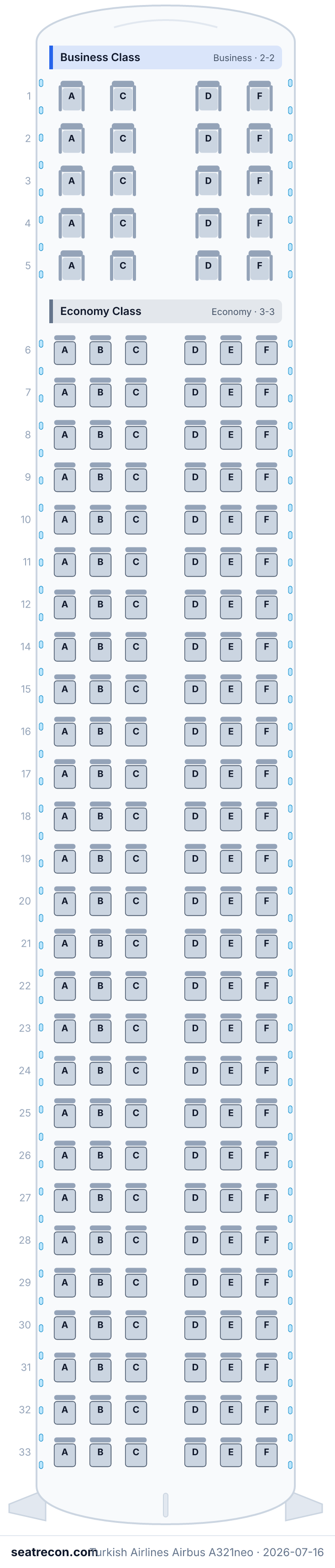
Mapa de asientos del Airbus A321neo de Turkish Airlines — 182 asientos
Mapa de asientos
Pasa el cursor o toca cualquier asiento para ver su valoración y detalles.
Toca o pasa el cursor sobre un asiento para ver su valoración y detalles. En el teléfono, pellizca para hacer zoom y arrastra para desplazarte.
Toca un número de asiento para verlo en el mapa.
Cómo valoramos los asientos →Guía de asientos
Orientación cabina por cabina generada a partir de los registros verificados de esta configuración: qué asientos destacan en las valoraciones, cuáles conviene pensarse dos veces y qué filas conviene conocer antes de elegir.
Business Class
Las valoraciones son uniformes en esta cabina — sin asientos destacados ni problemáticos en nuestros registros.
Economy Class
Las valoraciones son uniformes en esta cabina — sin asientos destacados ni problemáticos en nuestros registros.
Preguntas frecuentes
- ¿Cuántos asientos tiene el Airbus A321neo de Turkish Airlines?
- Esta configuración tiene 182 asientos: 20 Business Class, 162 Economy Class.
- ¿Cuáles son los mejores asientos del Airbus A321neo de Turkish Airlines?
- Las pruebas disponibles no permiten destacar ningún asiento en esta configuración. Los detalles de comodidad sin resolver siguen sin verificar.
- ¿Qué asientos debería evitar?
- Ningún asiento de esta distribución está señalado como asiento a evitar.
- ¿Tiene el Airbus A321neo de Turkish Airlines asientos cama (lie-flat)?
- No — esta configuración no tiene asientos cama.
Cabinas
Business Class
- Asiento
- Butaca reclinable
- Pantalla
- 13"
Economy Class
- Asiento
- Asiento estándar
- Pantalla
- 12"
Servicios a bordo
Imagen del mapa de asientos
Una captura imprimible de esta misma distribución — guárdala para consultarla el día del vuelo. El mapa interactivo de arriba sigue siendo la referencia definitiva.
Fuentes
Cada medida y afirmación de esta página se remonta a una de estas fuentes. Última verificación: 16 jul 2026.
Los extractos de las fuentes y las notas de investigación que siguen se citan en inglés, el idioma en el que fueron verificados.
- Turkish AirlinesFUENTE PRIMARIAConsultado el 16 jul 2026
Official A321neo fleet page: the aircraft joined the Turkish Airlines fleet in 2018 and provides 13-inch high-resolution Business Class screens, 12-inch Economy Class touchscreens, in-flight Wi-Fi and customizable cabin lighting.
The live endpoint timed out, so the snapshot is the latest available Wayback raw-bytes capture (2023-11-30). The page describes the type generically and does not publish cabin counts, abreast layouts, row numbers, seat letters, dimensions or a seat map.
https://www.turkishairlines.com/en-int/flights/fly-different/fleet/airbus-a321neo/ ↗ - WikipediaFUENTE INDEPENDIENTEConsultado el 14 jul 2026
Current-fleet table (updated June 2026): Turkish Airlines operates 58 A321neos and lists two passenger configurations, 20 Business / 162 Economy = 182 and 16 Business / 174 Economy = 190.
Neutral compilation used for current configuration scope and cabin totals only. It does not publish row maps or allocate the 58-aircraft fleet total between configurations.
https://en.wikipedia.org/wiki/Turkish_Airlines_fleet ↗ - Planespotters.netFUENTE INDEPENDIENTEConsultado el 16 jul 2026
Current production-list search results identify active Turkish Airlines A321neo airframes in both C20Y162 and C16Y174 configurations, confirming that both configurations are currently flying.
Planespotters returned HTTP 403 when fetched directly. This claim is limited to current search-index result snippets retrieved on 2026-07-16, so no source snapshot is available; it establishes active configuration scope, not row geometry.
https://www.planespotters.net/aircraft/search?dir=desc&fleet=Turkish-Airlines&fleetStatus=current&sort=reg ↗ - AirbusFUENTE PRIMARIAConsultado el 16 jul 2026
Manufacturer delivery release: Turkish Airlines would operate its first A321neo Cabin Flex aircraft with 20 Business and 162 Economy seats; it also describes the ACF removal of the door pair forward of the wing and introduction of overwing emergency exits.
This 2018 release proves the original 182-seat configuration and ACF architecture, but does not provide a row map, seat letters, dimensions or evidence for the later 190-seat configuration.
https://www.airbus.com/en/newsroom/press-releases/2018-07-airbus-delivers-the-first-a321neo-in-cabin-flex-configuration-to ↗ - Turkish AirlinesFUENTE PRIMARIAConsultado el 30 sept 2026
Current official fleet catalogue lists this aircraft model; it does not identify numbered layouts or each cabin-count variant.
2026-09-30 audit verified model listing only. The existing seat grid remains derived from prior cabin totals: rows, letters, partial rows and cabin boundaries are not verified against a numbered official map. Current subfleet split, hardware, measurements and operation of this exact capacity remain unresolved; lastVerifiedAt is retained.
https://www.turkishairlines.com/en-int/flights/fly-different/fleet/ ↗ - Turkish AirlinesFUENTE PRIMARIAConsultado el 30 sept 2026
Current official model specification page reviewed; generic type descriptions do not prove the individual configuration cabin split or layout.
2026-09-30 audit verified model listing only. The existing seat grid remains derived from prior cabin totals: rows, letters, partial rows and cabin boundaries are not verified against a numbered official map. Current subfleet split, hardware, measurements and operation of this exact capacity remain unresolved; lastVerifiedAt is retained.
https://www.turkishairlines.com/en-int/flights/fly-different/fleet/airbus-a321neo/ ↗
Airbus publishes Turkish Airlines' original A321neo Cabin Flex delivery configuration as 20 Business / 162 Economy = 182, while the current-fleet source still lists this configuration and current neutral airframe tracking identifies active C20Y162 aircraft. Turkish Airlines' fleet page confirms the shared A321neo cabin product and amenities but does not publish counts or a seat map. No permitted source located publishes an exact Turkish row map. The grid is therefore DERIVED: 5 conventional 2-2 Business rows (5 x 4 = 20) at modeled rows 1-5, followed by 27 conventional 3-3 Economy rows (27 x 6 = 162) at modeled rows 6-33 with row 13 omitted solely as a representational convention. All row numbers, seat letters, cabin boundaries and abreast layouts are modeling inferences rather than Turkish-published seat assignments. The aircraft.windowGridType binding uses SeatRecon's variant-exact A321neo ACF engineering grid, but all exact window alignments remain unknown because the row grid is derived. Monuments, exit-row placement, wing limits, bassinets, paid-seat zones, power, hardware dimensions and per-tail variation are intentionally not asserted. 2026-09-30 audit verified model listing only. The existing seat grid remains derived from prior cabin totals: rows, letters, partial rows and cabin boundaries are not verified against a numbered official map. Current subfleet split, hardware, measurements and operation of this exact capacity remain unresolved; lastVerifiedAt is retained.
Qué cambió
- 1 oct 2026Independent primary-source follow-up: correct source-specific product, provenance and furniture claims; retain unresolved layout uncertainty.
- 30 sept 2026Archived current primary fleet/type evidence; preserved prior derived geometry, status and verification date because exact current numbered map and configuration coverage remain unresolved.
- 16 jul 2026Initial Turkish Airlines A321neo 20J/162Y = 182 configuration; cabin totals sourced and row geometry explicitly derived.