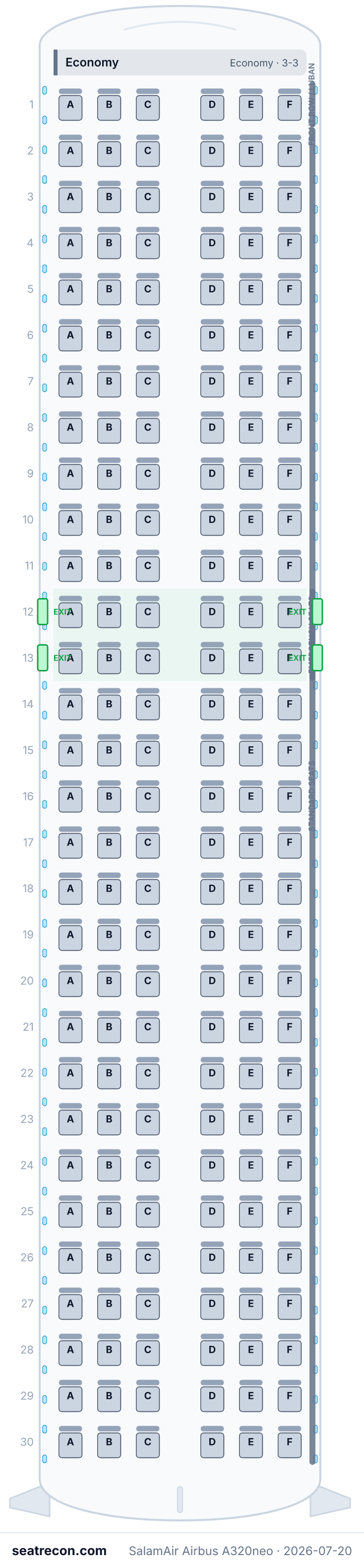
Mapa de asientos del Airbus A320neo de SalamAir
Mapa de asientos
Pasa el cursor o toca cualquier asiento para ver su valoración y detalles.
Toca o pasa el cursor sobre un asiento para ver su valoración y detalles. En el teléfono, pellizca para hacer zoom y arrastra para desplazarte.
- Filas de salida de emergencia: 12 y 13
Toca un número de asiento para verlo en el mapa.
Cómo valoramos los asientos →Guía de asientos
Orientación cabina por cabina generada a partir de los registros verificados de esta configuración: qué asientos destacan en las valoraciones, cuáles conviene pensarse dos veces y qué filas conviene conocer antes de elegir.
Economy
- Filas de salida de emergencia: 12 y 13
Preguntas frecuentes
- ¿Cuántos asientos tiene el Airbus A320neo de SalamAir?
- Esta configuración tiene 180 asientos: 180 Economy.
- ¿Cuáles son los mejores asientos del Airbus A320neo de SalamAir?
- Ningún asiento de esta distribución destaca en las valoraciones — la comodidad es uniforme entre filas.
- ¿Qué asientos debería evitar?
- Ningún asiento de esta distribución está señalado como asiento a evitar.
- ¿Qué filas son salidas de emergencia?
- Las filas 12 y 13 son filas de salida de emergencia.
- ¿Tiene el Airbus A320neo de SalamAir asientos cama (lie-flat)?
- No — esta configuración no tiene asientos cama.
Cabinas
Economy
- Asiento
- Asiento estándar
Instalaciones a bordo
Dibujadas en el mapa interactivo de arriba — pasa el cursor sobre un elemento para confirmar su posición.
2 pares de puertas
Imagen del mapa de asientos
Una captura imprimible de esta misma distribución — guárdala para consultarla el día del vuelo. El mapa interactivo de arriba sigue siendo la referencia definitiva.
Fuentes
Cada medida y afirmación de esta página se remonta a una de estas fuentes. Última verificación: 20 jul 2026.
Los extractos de las fuentes y las notas de investigación que siguen se citan en inglés, el idioma en el que fueron verificados.
- SalamAirFUENTE PRIMARIAConsultado el 20 jul 2026
Official fleet page publishes 180 seats for the A320neo and a 212-to-230-seat capacity range for the A321neo.
Its six-A320neo/nine-A321neo/15-aircraft fleet count predates SalamAir's 15 July 2026 release describing 18 A320neo-family aircraft overall; it is used for capacities, not a current type fleetCount.
https://www.salamair.com/en/about-us-f/fleet-information ↗ - SalamAirFUENTE PRIMARIAConsultado el 20 jul 2026
Official seat-selection page identifies first-row, emergency, and standard seat products.
The generic product page does not assign those products to configuration-specific row numbers; the booking-map responses provide the row grid and exit flags.
https://www.salamair.com/en/book/select-a-seat ↗ - SalamAir Media CentreFUENTE PRIMARIAConsultado el 20 jul 2026
Official product release identifies the front row of both the A320neo and A321neo as the Luban seating class.
This is a 2021 product release. The current booking API retains LUBAN service codes, calls the A321 front cabin BUSINESS, and calls the A320 cabin ECONOMY, so Luban is treated as a product name rather than evidence of a second A320 physical cabin.
https://press.salamair.com/introducing-the-new-seating-class-luban/ ↗ - SalamAir Media CentreFUENTE PRIMARIAConsultado el 20 jul 2026
Official 15 July 2026 release confirms that the newest A320neo entered commercial service and that SalamAir then operated 18 A320neo-family aircraft overall.
The release does not split the 18-aircraft family total by A320ceo, A320neo, and A321neo, so no per-type fleetCount is inferred.
https://press.salamair.com/salamair-welcomes-its-18th-aircraft-salalah-supporting-omans-growth-and-connectivity/ ↗ - SalamAir booking APIFUENTE PRIMARIAConsultado el 20 jul 2026
Public booking search associates logical flight 1883341 / physical leg 229490 (OV151 MCT-SLL on 5 August 2026) with aircraftType 32N.
The response is a point-in-time schedule search; the exact request is preserved in searchRequest in the snapshot.
https://api.salamair.com/api/flights ↗ - SalamAir booking APIFUENTE PRIMARIAConsultado el 20 jul 2026
Published seat response for the associated leg identifies configuration Y180, one ECONOMY cabin, rows 1-30 with seats A-F in every row, and exit-seat flags on rows 12-13.
The endpoint is session-scoped and requires a fresh anonymous booking session to replay; the raw response is retained in the snapshot.
https://api.salamair.com/api/booking/Seats ↗
CURRENT OFFICIAL BOOKING MAP. A scheduled SalamAir 32N leg resolves to booking configuration Y180: one Economy cabin with 30 complete 3-3 rows, numbered 1-30, for 180 seats. The carrier response flags every seat in rows 12-13 as an exit seat. The row grid, installed seat letters, cabin identity, configuration code and exit-seat rows are therefore published_map facts, not count-derived reconstruction. The historical Luban release dedicates the front row to that product, while the current response labels the sole physical cabin ECONOMY; row 1 is modelled as a product zone, not a separate cabin or unverified extra-legroom seat type. Exit-door objects are conservative derived anchors for validator/display support at the carrier-published exit rows; the API does not publish a monument drawing or door subtype. No pitch, width, recline, seat model, USB coverage, exact wing extent, bulkhead, galley/lavatory layout, no-recline row, or seat drawback is asserted. The exact A320neo engineering window grid is bound; window seats remain unknown unless the repository classifier proves a structural blank. FLEET COUNT WITHHELD: the live fleet page's six-A320neo/nine-A321neo/15-aircraft breakdown predates the 15 July 2026 release describing 18 A320neo-family aircraft overall and does not split the new family total by subtype.
Qué cambió
- 20 jul 2026Initial SalamAir A320neo Y180 configuration generated from the carrier's live booking seat response for a scheduled 32N leg.