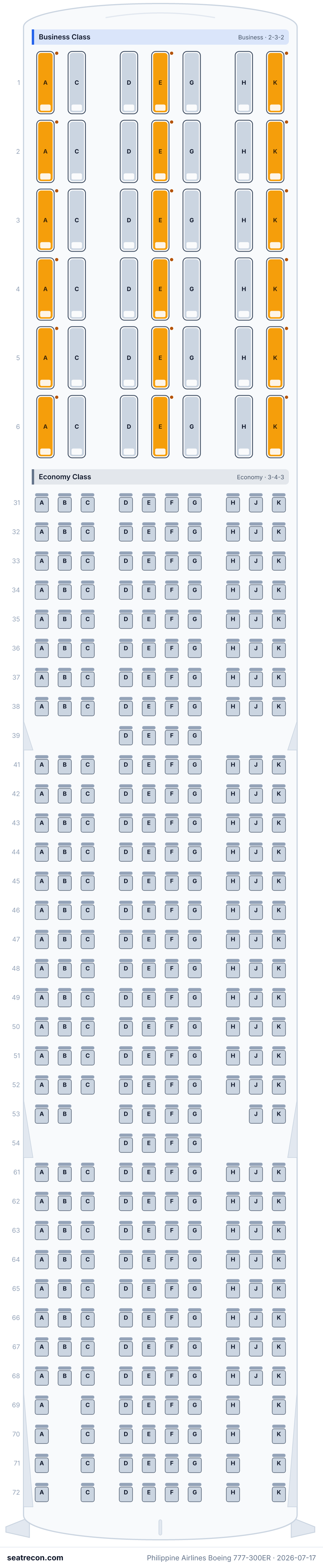
Denah kursi Philippine Airlines Boeing 777-300ER — 370 kursi
Penilaian kursi
Penilaian ditinjau berdasarkan sumber yang dikutip. Detail tanpa bukti memadai, termasuk posisi jendela yang belum diketahui, belum diverifikasi.
Peta kursi
Arahkan kursor atau ketuk kursi mana pun untuk melihat penilaian dan detailnya.
Ketuk atau arahkan kursor ke kursi untuk melihat penilaian dan detailnya. Di ponsel, cubit untuk memperbesar dan seret untuk menggeser.
- — Business window or centre-middle seat: reaching the aisle passes a neighbour in the exact published 2-3-2 grid.
- Baris dengan posisi keranjang bayi (bassinet): 1, 5, 31, dan 61
Ketuk nomor kursi untuk melihatnya di denah.
Cara kami menilai kursi →Kursi terbaik & terburuk
Pilihan mesin penilai kami untuk tata letak kabin ini — lihat alasan lengkap tiap kursi di peta di atas.
Perlu diketahui
- 1A, 1E, 1K, 2A, 2E, 2K — Business window or centre-middle seat: reaching the aisle passes a neighbour in the exact published 2-3-2 grid.
Panduan kursi
Panduan per kabin yang dihasilkan dari catatan tata letak terverifikasi di balik denah ini: kursi mana yang unggul dalam penilaian, mana yang perlu dipikirkan dua kali, dan baris mana yang perlu diketahui sebelum memilih.
Business Class
Kursi yang sebaiknya dihindari
- 1A, 1E, 1K, 2A, 2E, 2K, 3A, 3E, 3K, 4A, 4E, 4K — Business window or centre-middle seat: reaching the aisle passes a neighbour in the exact published 2-3-2 grid.
- Baris dengan posisi keranjang bayi (bassinet): 1 dan 5
- Baris di samping dapur (galley): 1, 4, dan 5
- Baris di samping toilet: 5
Economy Class
Kursi yang sebaiknya dihindari
- 38A, 38B, 38C, 38H, 38J, 38K — Nearest populated block to the outer lavatory bank after row 38 shown in the native schematic; possible lavatory use noise or nearby queueing are unmeasured editorial cautions. Correlated service effects count as one caution.
- 39D, 39E, 39F, 39G — Nearest populated block to the two distinct central lavatories after row 39 shown in the native schematic; possible lavatory use noise or nearby queueing are unmeasured editorial cautions. Correlated service effects count as one caution.
- 41A, 41B — Nearest populated block to the outer lavatories after row 38 and central lavatory pair after row 39 shown in the native schematic; possible lavatory use noise or nearby queueing are unmeasured editorial cautions. Correlated service effects count as one caution.
- Baris dengan posisi keranjang bayi (bassinet): 31 dan 61
- Baris di samping dapur (galley): 54, 61, dan 72
- Baris di samping toilet: 38, 39, 41, dan 53
Pertanyaan umum
- Berapa jumlah kursi Boeing 777-300ER Philippine Airlines?
- Konfigurasi ini memuat 370 kursi: 42 Business Class, 328 Economy Class.
- Kursi mana yang terbaik di Boeing 777-300ER Philippine Airlines?
- Bukti yang tersedia belum menetapkan kursi unggulan pada tata letak ini. Detail kenyamanan yang belum jelas tetap belum terverifikasi.
- Kursi mana yang sebaiknya dihindari?
- Ditandai dalam data kami: 1A, 1E, 1K, 2A, 2E, 2K, 3A, 3E — Business window or centre-middle seat: reaching the aisle passes a neighbour in the exact published 2-3-2 grid.
- Baris mana yang memiliki posisi keranjang bayi?
- Posisi keranjang bayi melayani baris 1, 5, 31, dan 61.
- Apakah Boeing 777-300ER Philippine Airlines punya kursi lie-flat?
- Ya — Business Class memiliki 42 kursi yang bisa menjadi tempat tidur rata sepenuhnya.
Kabin
Business Class
- Jarak kursi
- 78"resmi
- Lebar
- 20.4"resmi
- Kursi
- Tempat tidur lie-flat
- Layar
- Ada layar (ukuran tidak dipublikasikan)
- Daya
- Stopkontak AC · USB-A
Di kabin ini: Wi-Fi tersedia · Daya: Stopkontak AC, USB-A · Hiburan: seatback
Economy Class
- Jarak kursi
- 33"resmi
- Lebar
- 18.4"resmi
- Kursi
- Kursi standar
- Layar
- Ada layar (ukuran tidak dipublikasikan)
- Daya
- USB-A
Di kabin ini: Wi-Fi tersedia · Daya: USB-A · Hiburan: seatback
Fasilitas kabin
Digambar di peta interaktif di atas — arahkan kursor ke fasilitasnya untuk memastikan posisinya.
11 toilet · 10 galley · 4 pasang pintu
Layanan di pesawat
Gambar peta kursi
Cuplikan tata letak ini yang siap dicetak — simpan untuk rujukan di hari keberangkatan. Peta interaktif di atas tetap menjadi acuan utama.
Sumber
Setiap ukuran dan klaim di halaman ini ditelusuri ke salah satu sumber berikut. Terakhir diverifikasi 6 Okt 2026.
Kutipan sumber dan catatan riset di bawah ini ditampilkan dalam bahasa Inggris — bahasa asli tempat data tersebut diverifikasi.
- Philippine AirlinesSUMBER PRIMERDiakses 17 Jul 2026
Historical fleet-index record lists the 370-seat Boeing 777-300ER product; current cabin split and specifications are sourced to the separately cited accommodation model.
Retained July source snapshot and retrieval date. The previous attribution of the 42/328 cabin split to the fleet index is superseded; the current accommodation model supports those counts.
https://www.philippineairlines.com/ph/en/inflight-experience/airfleet.html ↗ - WikipediaSUMBER INDEPENDENDiakses 17 Jul 2026
As-of-2026 Philippine Airlines fleet table independently corroborates the in-service 370-seat Boeing 777-300ER (42 Business / 328 Economy), its cabin split and its total.
Neutral fleet-table cross-check; PAL's own current accommodation pages remain authoritative for hardware dimensions, and PAL's Comfort advisory defines that branded domestic product.
https://en.wikipedia.org/wiki/Philippine_Airlines_fleet ↗ - Philippine AirlinesSUMBER PRIMERDiakses 17 Jul 2026
Current operating-fleet page publishes 42 Business and 328 Economy seats, 2-3-2 and 3-4-3 layouts, pitch, width, recline, IFE, power and Wi-Fi availability.
The live HTML is an application shell; the snapshot is the official AEM page-model JSON containing the rendered accommodation table and asset references.
https://www.philippineairlines.com/ph/en/inflight-experience/airfleet/airfleet-plane-list/pal-operating-fleet/boeing-777-300er-370-seater.html ↗ - Philippine AirlinesSUMBER PRIMERDiakses 17 Jul 2026
Official 370-seat 777-300ER raster supplies row-number blocks, seat letters, cabin breaks, facilities and taper geometry.
Retained July native-image source record. Its former count-reconciliation interpretation is superseded by the October 6 exact native seat transcription. Current rows and columns are not selected or omitted to fit a specification total.
https://www.philippineairlines.com/content/dam/palportal/migration/files/airfleet-360/b777-300er-370-seater/seat-map-2.png ↗ - Philippine AirlinesSUMBER PRIMERDiakses 6 Okt 2026
Current official fleet-index model lists aircraft products and links to their accommodation pages. Named seater labels support product listing; cabin accommodation tables and seat-type specifications are supplied by the separate product models.
Fleet listing supports the offered aircraft product only; cabin counts, dimensions and amenities are sourced to the separate accommodation model, and exact seats to the native chart.
https://www.philippineairlines.com/ph/en/inflight-experience/airfleet.model.json ↗ - Philippine AirlinesSUMBER PRIMERDiakses 6 Okt 2026
Current official accommodation model publishes cabin counts, seat-type specifications and product amenities; it does not establish exact window alignment.
Native schematic is not measured geometry; engineering alignment disabled. Selection designations do not determine comfort ratings.
https://www.philippineairlines.com/ph/en/inflight-experience/airfleet/airfleet-plane-list/pal-operating-fleet/boeing-777-300er-370-seater.model.json ↗ - Philippine AirlinesSUMBER PRIMERDiakses 6 Okt 2026
Current official native numbered seat diagram and categorical selection legend.
Native schematic is not measured geometry; engineering alignment disabled. Selection designations do not determine comfort ratings.
https://www.philippineairlines.com/content/dam/palportal/migration/files/airfleet-360/b777-300er-370-seater/seat-map-2.png ↗
Current numbered diagram: 42 Business and 328 Economy seats, with Business ACDEFHK and Economy 3-4-3 grids. Historical configuration ID and URL are retained; Business 1G-6G are corrected to the native letters 1F-6F. Furniture comprises 10 distinct galley compartments, 11 lavatories and 4 source-drawn bilateral EXIT bands. Banks and EXIT-relative order are categorical schematic readings, not measured geometry. Proximity caps are not applied to banks wholly across a drawn EXIT axis; a source footprint overlapping the axis toward the nearest chair block may support one qualified caution. Service activity remains unmeasured and a baseline rating does not promise quiet. The native diagram draws no galley or lavatory at 6/31. The centre galley aft of Door 3 is nearest 61D/E/F/G; the centre galley fore of Door 4 is nearest 72D/E/F/G. Row 41 is nearest the drawn lavatory bank after rows 38 and 39; possible undrawn separators remain unverified. Historical July source interpretations are superseded by the current exact native transcription and accommodation tables. Physical exit markers follow explicit native EXIT arrows only. Other exit positions are unverified, not claimed absent. Exact Exit Row, bassinet, wheelchair, minor and nut-allergy designations are disclosed per seat and do not establish comfort advantages or restrictions on other passengers. Wall geometry, per-seat armrests, trays, storage and recline exceptions remain unverified. No engineering window grid is bound; all outboard alignments remain unknown.
Riwayat perubahan
- 6 Okt 2026Compared with the July 17 baseline, 1D, 1F, 4D, 4F, 5C, 5D, 5F, 5H, 38A, 38B, 38C, 38H, 38J, 38K, 39D, 39E, 39F, 39G, 41A, 41B, 41C, 41D, 41E, 41F, 41G, 41H, 41J, 41K, 53A, 53B, 53J, 53K, 54D, 54E, 54F, 54G, 61D, 61E, 61F, 61G, 72D, 72E, 72F, 72G move from Standard to Be Aware for qualified nearest-bank service cautions. No seat is upgraded. Ratings change from 18 Be Aware / 352 Standard to 62 Be Aware / 308 Standard. Corrected Business 1G-6G to the source letters 1F-6F; Economy identities and the historical configuration ID and URL are retained. Individually transcribed 10 galley compartments, 11 lavatories and 4 source-drawn bilateral EXIT bands with categorical bank order. Added exact selection-designation notes to 178 seats without changing comfort tiers for eligibility alone. Updated source attribution and per-seat reasons. Unsupported bulkhead wall attributes are not retained. Outboard window alignment remains unknown; unsupported engineering-window binding is not used.
- 17 Jul 2026Initial Philippine Airlines 370-seat widebody configuration.