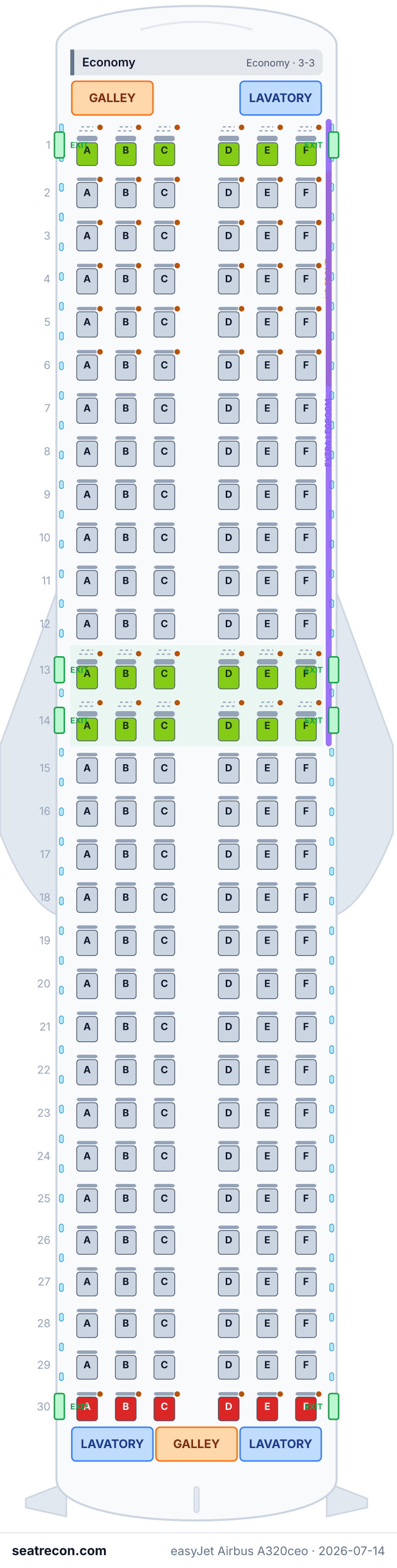
Denah kursi easyJet Airbus A320ceo — 180 kursi
Peta kursi
Arahkan kursor atau ketuk kursi mana pun untuk melihat penilaian dan detailnya.
Ketuk atau arahkan kursor ke kursi untuk melihat penilaian dan detailnya. Di ponsel, cubit untuk memperbesar dan seret untuk menggeser.
- — No under-seat storage; bags go in the overhead bin for take-off and landing
- — Next to the rear galley and lavatories: noise, queueing and high foot traffic
- Baris pintu darurat: 13 dan 14
- 18 kursi dengan ruang kaki ekstra
- 18 kursi tanpa ruang penyimpanan di bawah kursi
Ketuk nomor kursi untuk melihatnya di denah.
Cara kami menilai kursi →Kursi terbaik & terburuk
Pilihan mesin penilai kami untuk tata letak kabin ini — lihat alasan lengkap tiap kursi di peta di atas.
Kursi yang sebaiknya dihindari
- 30A, 30B, 30C, 30D, 30E, 30F — Next to the rear galley and lavatories: noise, queueing and high foot traffic
Panduan kursi
Panduan per kabin yang dihasilkan dari catatan tata letak terverifikasi di balik denah ini: kursi mana yang unggul dalam penilaian, mana yang perlu dipikirkan dua kali, dan baris mana yang perlu diketahui sebelum memilih.
Economy
Kursi terbaik
- 1A, 1B, 1C, 1D, 1E, 1F — No under-seat storage; bags go in the overhead bin for take-off and landing
- 13A, 13B, 13C, 13D, 13E, 13F — Over-wing emergency exit row — extra legroom
Kursi yang sebaiknya dihindari
- 30A, 30B, 30C, 30D, 30E, 30F — Next to the rear galley and lavatories: noise, queueing and high foot traffic
- Baris pintu darurat: 13 dan 14
- Baris di samping dapur (galley): 30
- 18 kursi dengan ruang kaki ekstra
- 18 kursi tanpa ruang penyimpanan di bawah kursi
Pertanyaan umum
- Berapa jumlah kursi Airbus A320ceo easyJet?
- Konfigurasi ini memuat 180 kursi: 180 Economy.
- Kursi mana yang terbaik di Airbus A320ceo easyJet?
- Penilaian tertinggi dalam data kami: 1A, 1B, 1C, 1D, 1E, 1F — No under-seat storage; bags go in the overhead bin for take-off and landing; 13A, 13B — Over-wing emergency exit row — extra legroom.
- Kursi mana yang sebaiknya dihindari?
- Ditandai dalam data kami: 30A, 30B, 30C, 30D, 30E, 30F — Next to the rear galley and lavatories: noise, queueing and high foot traffic.
- Baris mana yang merupakan baris pintu darurat?
- Baris 13 dan 14 adalah baris pintu darurat.
- Apakah Airbus A320ceo easyJet punya kursi lie-flat?
- Tidak — konfigurasi ini tidak punya kursi lie-flat.
Kabin
Economy
- Jarak kursi
- 28–35"estimasi
- Lebar
- 16"min
- Kursi
- Kursi slimline, Kursi ruang kaki ekstra
Primary guidance publishes fleet-wide minimum pitch28in and width16in. These minimums do not establish the retained row-band assignment, actual installed width/pitch or reclining mechanism; other retained measurements remain unverified estimates.
Fasilitas kabin
Digambar di peta interaktif di atas — arahkan kursor ke fasilitasnya untuk memastikan posisinya.
3 toilet · 2 galley · 4 pasang pintu
Layanan di pesawat
Gambar peta kursi
Cuplikan tata letak ini yang siap dicetak — simpan untuk rujukan di hari keberangkatan. Peta interaktif di atas tetap menjadi acuan utama.
Sumber
Setiap ukuran dan klaim di halaman ini ditelusuri ke salah satu sumber berikut. Terakhir diverifikasi 14 Jul 2026.
Kutipan sumber dan catatan riset di bawah ini ditampilkan dalam bahasa Inggris — bahasa asli tempat data tersebut diverifikasi.
- easyJetSUMBER PRIMERDiakses 14 Jul 2026
The archived easyJet fleet help page says318 Airbus A320-family aircraft and describes its aircraft families. The undated page does not verify a single-class layout, seat hardware or amenities; the newer dated official fleet inventory is retained separately.
https://www.easyjet.com/en/help/boarding-and-flying/our-fleet ↗ - easyJetSUMBER PRIMERDiakses 14 Jul 2026
Up Front = rows 2-6 (2-5 on some aircraft); Extra Legroom offers extra legroom plus Up Front benefits; minimum seat pitch 28in/71cm and minimum width 16in/40.5cm; emergency-exit-row rules (16+, not travelling with infants, willing/able to assist); exit/restricted rows vary by aircraft type.
https://www.easyjet.com/en/help/booking-and-check-in/choosing-a-seat ↗ - WikipediaSUMBER INDEPENDENDiakses 14 Jul 2026
easyJet fleet table (as of March 2026): Airbus A320-200 is the largest operator's subfleet — 25 aircraft configured for 180 passengers and 155 aircraft configured for 186 passengers (single-class); A319-100 156 seats; A320neo 186 seats.
https://en.wikipedia.org/wiki/EasyJet ↗ - WikipediaSUMBER INDEPENDENDiakses 14 Jul 2026
Airbus A320 (A320-200) is 37.6 m long and accommodates 150 to 186 passengers, six-abreast; CFM56-5B-powered variant is the A320-214; the A320 has two over-wing emergency exits per side (four total).
https://en.wikipedia.org/wiki/Airbus_A320_family ↗ - easyJetSUMBER PRIMERDiakses 30 Sep 2026
Fleet at 31 March 2026: 79 A319 at156, 180 A320 at180 or186, 75 A320neo at186,22 A321neo at235.
Text extracted through web reader; direct archive returned403. A320 capacity split is unpublished.
https://corporate.easyjet.com/about/easyJet-Airline/default.aspx ↗ - easyJetSUMBER PRIMERDiakses 30 Sep 2026
Fleet-wide minimum seat pitch28in and width16in; Up Front rows2–6 or2–5; Extra Legroom seat product.
No variant-exact numbered diagram or per-row dimensions.
https://www.easyjet.com/en/help/booking-and-check-in/choosing-a-seat ↗
Retained easyJet A320ceo configuration: 180 installed seats represented by a count-derived single Economy cabin. Every numbered row, partial row, exit-row assignment, wing span, monument location and per-seat physical restriction remains unverified by a variant-exact airline diagram. Existing structural coordinates are preserved, not newly certified. Up Front and Extra Legroom are selection products within that cabin; the N summary token records a canonical extra-legroom Economy subdivision, not an additional physical cabin. Primary guidance lists Up Front rows2–6 or2–5 on some aircraft and a small under-seat cabin bag, but does not bind its exact row band, identical hardware, or faster boarding to this variant. The published28in pitch/16in width are fleet-wide minimums; particular rear row assignments and other measurements remain estimates. Hardware manufacturer and reclining mechanism are withheld; unsupported bassinet, misaligned-window, narrow-seat and per-row recline flags are removed. Retained ratings and other furniture/eligibility annotations are historical modelling assumptions, not newly verified passenger policies. No new door or monument coordinate is inferred from generic aircraft stations. Amenities and per-tail product/retrofit allocation remain unverified. Earlier neutral fleet quantities and retirement claims are not reaffirmed; the appended official dated inventory is the count source. No complete configuration certification.
Riwayat perubahan
- 1 Okt 2026Remove absent source-field hints; preserve all source records and evidence without introducing facts or new claim bindings. Qualify unsupported easyJet hardware, reclining mechanism, bassinet/window/width warnings and source scope; preserve count-derived seat topology and valid canonical cabin summary.
- 30 Sep 2026European primary-source audit: Official capacity and dated type inventory; Fleet-wide minimum28in pitch/16in width; Up Front location tier and Extra Legroom product definitions. Unresolved: Every retained row and partial-row arrangement is count-derived; exact numbered layout unavailable; Per-row pitch, exit rows, recline and hardware assignments, service monuments and amenities; A320180/186 allocation; individual retrofit status and future new-seat installations.
- 14 Jul 2026Initial easyJet A320-200 (A320ceo, 180-seat single-class) config created from easyJet fleet + choosing-a-seat pages, Wikipedia easyJet fleet table, and Wikipedia A320 family; layout derived from counts + Airbus A320 ACAP door geometry. Independent verification found the A320-200 subfleet splits into 180-seat (25 ac) and 186-seat (155 ac) configs; the 186-seat config is authored as u2-320-186.