Denah kursi American Airlines Airbus A320ceo
Peta kursi
Arahkan kursor atau ketuk kursi mana pun untuk melihat penilaian dan detailnya.
Ketuk atau arahkan kursor ke kursi untuk melihat penilaian dan detailnya. Di ponsel, cubit untuk memperbesar dan seret untuk menggeser.
- 12 kursi dengan ruang kaki ekstra
Ketuk nomor kursi untuk melihatnya di denah.
Cara kami menilai kursi →Panduan kursi
Panduan per kabin yang dihasilkan dari catatan tata letak terverifikasi di balik denah ini: kursi mana yang unggul dalam penilaian, mana yang perlu dipikirkan dua kali, dan baris mana yang perlu diketahui sebelum memilih.
First
Penilaian merata di kabin ini — tidak ada kursi unggulan atau bermasalah dalam catatan kami.
Main Cabin
- 12 kursi dengan ruang kaki ekstra
Pertanyaan umum
- Berapa jumlah kursi Airbus A320ceo American Airlines?
- Konfigurasi ini memuat 150 kursi: 12 First, 138 Main Cabin.
- Kursi mana yang terbaik di Airbus A320ceo American Airlines?
- Bukti yang tersedia belum menetapkan kursi unggulan pada tata letak ini. Detail kenyamanan yang belum jelas tetap belum terverifikasi.
- Kursi mana yang sebaiknya dihindari?
- Tidak ada kursi di tata letak ini yang ditandai untuk dihindari.
- Apakah Airbus A320ceo American Airlines punya kursi lie-flat?
- Tidak — konfigurasi ini tidak punya kursi lie-flat.
Kabin
First
- Jarak kursi
- 36"resmi
- Lebar
- 21"resmi
- Kursi
- Kursi recliner
Pitch and width from American Airlines fleet table, retrieved 2026-09-30. Ranges describe the published product; individual seat values are not specified. Other dimensions remain unverified when marked unsourced.
Main Cabin
- Jarak kursi
- 31.5"resmi
- Lebar
- 17.3"resmi
- Kursi
- Kursi standar, Kursi ruang kaki ekstra
Pitch and width from American Airlines fleet table, retrieved 2026-09-30. Ranges describe the published product; individual seat values are not specified. Other dimensions remain unverified when marked unsourced.
Layanan di pesawat
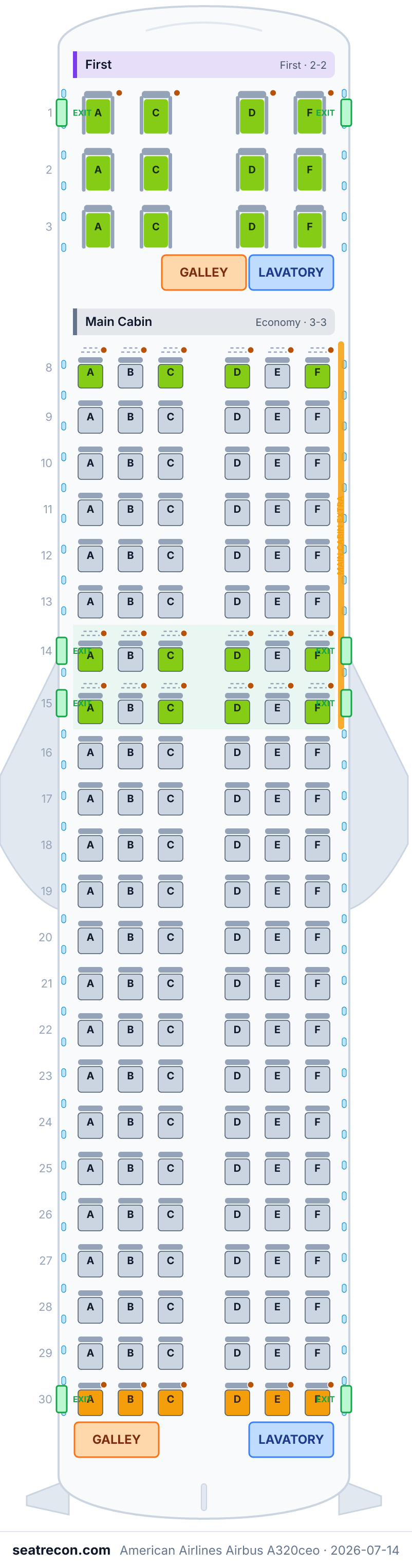
Gambar peta kursi
Cuplikan tata letak ini yang siap dicetak — simpan untuk rujukan di hari keberangkatan. Peta interaktif di atas tetap menjadi acuan utama.
Sumber
Setiap ukuran dan klaim di halaman ini ditelusuri ke salah satu sumber berikut. Terakhir diverifikasi 14 Jul 2026.
Kutipan sumber dan catatan riset di bawah ini ditampilkan dalam bahasa Inggris — bahasa asli tempat data tersebut diverifikasi.
- SEC EDGAR (American Airlines Group Inc. FY2025 Form 10-K)SUMBER PRIMERDiakses 14 Jul 2026
Mainline fleet table: Airbus A320 total 48 aircraft (12 owned / 36 leased), average 150 seats, average age 24.7 years, as of 2025-12-31. No cabin-class splits given.
https://www.sec.gov/Archives/edgar/data/6201/000000620126000014/aal-20251231.htm ↗ - Wikipedia (American Airlines fleet)SUMBER INDEPENDENDiakses 14 Jul 2026
Fleet table: Airbus A320-200 current config 12 First / 18 Main Cabin Extra / 120 Main Cabin = 150 seats (48 in service); a second row shows a coming 16 First / 33 Main Cabin Extra / 101 Main Cabin reconfiguration with an em-dash (none) in service, noted 'Being reconfigured with more first class seats and new interior.'
https://en.wikipedia.org/wiki/American_Airlines_fleet ↗ - American AirlinesSUMBER PRIMERDiakses 30 Sep 2026
Current published cabin counts and product pitch/width for aa-320-150.
Snapshot is a saved web-tool text extraction, not raw HTML. Product counts and specifications only; no numbered seat map. Does not establish row numbers, MCE seat assignments, monuments, ratings or window alignment.
https://www.aa.com/web/i18n/travel-info/experience/planes/planes.html ↗ - American AirlinesSUMBER PRIMERDiakses 30 Sep 2026
Complete numbered seat presence and published MCE/exit/wing/no-window labels for USH sample AA2983 CLT–MSY 2026-11-05.
Normalized rendered DOM extraction; session URLs may expire. No claim of all-tail uniformity or monument coordinates; booking availability excluded.
https://www.aa.com/seats/app/view-only/257ad847-4049-465a-a16c-804c082893ee ↗
Numbered seat grid, MCE allocation, wing rows, exit-seat and no-window labels verified against American view-only sample AA2983 CLT–MSY on 2026-11-05, retrieved 2026-09-30. Equipment CSS USH. Total/product counts and pitch/width checked against American fleet table. Temporary availability is not structural and does not affect bookability. Monument coordinates, recline/bed length, amenity details, fleet counts, individual window alignment beyond explicitly labelled blanks and retrofit dates remain unverified. Historical unsourced monuments and seat ratings removed when grid replaced. This proves the sampled variant, not every aircraft tail. SEC FY2025 type inventory records48 A320 aircraft with average150seats; this is type-level evidence, not an independently bound per-tail inventory for the sampled layout. Adjustable headrests, slimline hardware, AC/USB connector type, Wi-Fi price and food/drink terms are not independently supported by the frozen evidence. Source-supported general power availability and personal-device IFE remain separately represented.
Riwayat perubahan
- 1 Okt 2026Source-supported factual/provenance corrections and explicit source limits; preserve numbered seat topology and counts.
- 30 Sep 2026Replace inferred row grid with observed American USH numbered map; correct MCE/exit/no-window locations, remove unsupported monument and per-seat rating assumptions. Sample AA2983 2026-11-05.
- 30 Sep 2026Partial primary-source audit: replace estimated pitch/width with American published measurements; retain historical verification date and derived layout.
- 14 Jul 2026Initial American A320-200 standard 150-seat config (12 First / 18 Main Cabin Extra / 120 Main Cabin). Fleet total/average from FY2025 10-K (48 aircraft, avg exactly 150 seats); cabin split from Wikipedia fleet table; row grid derived from A320 ACAP door/over-wing-exit stations (two consecutive Type III over-wing exit rows). Coming 16-First reconfiguration noted but not modeled (not yet in service).