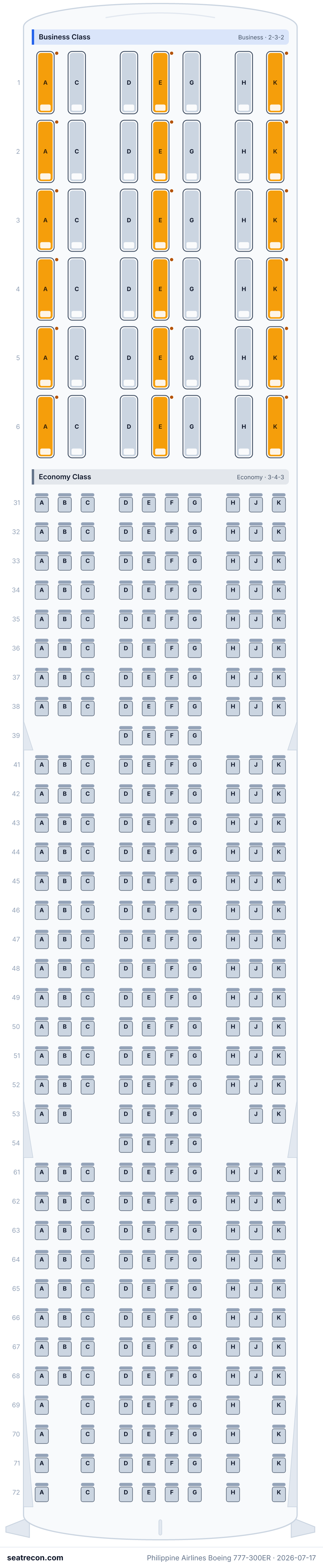
Philippine Airlines Boeing 777-300ER seat map — 370 seats
Seat assessment
Ratings reviewed against the cited evidence. Details without sufficient evidence, including unknown window alignment, remain unverified.
Seat map
Hover or tap any seat to see its rating and details.
Tap or hover a seat for its rating and details. On a phone, pinch to zoom and drag to pan.
- — Business window or centre-middle seat: reaching the aisle passes a neighbour in the exact published 2-3-2 grid.
- Bassinet rows: 1, 5, 31, and 61
Tap a seat number to jump to it on the map.
How we rate seats →Best & worst seats
Our rating engine's picks for this cabin layout — see any seat's full reasoning in the map above.
Worth knowing
- 1A, 1E, 1K, 2A, 2E, 2K — Business window or centre-middle seat: reaching the aisle passes a neighbour in the exact published 2-3-2 grid.
Seat guide
Cabin-by-cabin guidance generated from the verified layout records behind this map — which seats the ratings favor, which to think twice about, and the rows worth knowing about before you pick.
Business Class
Seats to avoid
- 1A, 1E, 1K, 2A, 2E, 2K, 3A, 3E, 3K, 4A, 4E, 4K — Business window or centre-middle seat: reaching the aisle passes a neighbour in the exact published 2-3-2 grid.
- Bassinet rows: 1 and 5
- Rows next to a galley: 1, 4, and 5
- Rows next to a lavatory: 5
Economy Class
Seats to avoid
- 38A, 38B, 38C, 38H, 38J, 38K — Nearest populated block to the outer lavatory bank after row 38 shown in the native schematic; possible lavatory use noise or nearby queueing are unmeasured editorial cautions. Correlated service effects count as one caution.
- 39D, 39E, 39F, 39G — Nearest populated block to the two distinct central lavatories after row 39 shown in the native schematic; possible lavatory use noise or nearby queueing are unmeasured editorial cautions. Correlated service effects count as one caution.
- 41A, 41B — Nearest populated block to the outer lavatories after row 38 and central lavatory pair after row 39 shown in the native schematic; possible lavatory use noise or nearby queueing are unmeasured editorial cautions. Correlated service effects count as one caution.
- Bassinet rows: 31 and 61
- Rows next to a galley: 54, 61, and 72
- Rows next to a lavatory: 38, 39, 41, and 53
Frequently asked questions
- How many seats does the Philippine Airlines Boeing 777-300ER have?
- This configuration has 370 seats: 42 Business Class, 328 Economy Class.
- What are the best seats on the Philippine Airlines Boeing 777-300ER?
- No standout seat is established by the available evidence for this layout. Unresolved comfort details remain unverified.
- Which seats should I avoid?
- Flagged in our data: 1A, 1E, 1K, 2A, 2E, 2K, 3A, 3E — Business window or centre-middle seat: reaching the aisle passes a neighbour in the exact published 2-3-2 grid.
- Which rows have bassinet positions?
- Bassinet positions serve rows 1, 5, 31, and 61.
- Does the Philippine Airlines Boeing 777-300ER have lie-flat seats?
- Yes — Business Class has 42 seats that convert to a fully flat bed.
Cabins
Business Class
- Pitch
- 78"published
- Width
- 20.4"published
- Seat
- Lie-flat bed
- Screen
- Screen fitted (size unpublished)
- Power
- AC power outlet · USB-A
In this cabin: Wi-Fi available · Power: AC power outlet, USB-A · Entertainment: seatback
Economy Class
- Pitch
- 33"published
- Width
- 18.4"published
- Seat
- Standard seat
- Screen
- Screen fitted (size unpublished)
- Power
- USB-A
In this cabin: Wi-Fi available · Power: USB-A · Entertainment: seatback
Onboard facilities
Drawn on the interactive map above — hover a monument to confirm its position.
11 lavatories · 10 galleys · 4 door pairs
Amenities
Seat map image
A printable snapshot of this exact layout — save it for boarding-day reference. The interactive map above stays the source of truth.
Sources
Every measurement and claim on this page traces back to one of these. Last verified Oct 6, 2026.
- Philippine AirlinesPRIMARY SOURCERetrieved Jul 17, 2026
Historical fleet-index record lists the 370-seat Boeing 777-300ER product; current cabin split and specifications are sourced to the separately cited accommodation model.
Retained July source snapshot and retrieval date. The previous attribution of the 42/328 cabin split to the fleet index is superseded; the current accommodation model supports those counts.
https://www.philippineairlines.com/ph/en/inflight-experience/airfleet.html ↗ - WikipediaINDEPENDENT SOURCERetrieved Jul 17, 2026
As-of-2026 Philippine Airlines fleet table independently corroborates the in-service 370-seat Boeing 777-300ER (42 Business / 328 Economy), its cabin split and its total.
Neutral fleet-table cross-check; PAL's own current accommodation pages remain authoritative for hardware dimensions, and PAL's Comfort advisory defines that branded domestic product.
https://en.wikipedia.org/wiki/Philippine_Airlines_fleet ↗ - Philippine AirlinesPRIMARY SOURCERetrieved Jul 17, 2026
Current operating-fleet page publishes 42 Business and 328 Economy seats, 2-3-2 and 3-4-3 layouts, pitch, width, recline, IFE, power and Wi-Fi availability.
The live HTML is an application shell; the snapshot is the official AEM page-model JSON containing the rendered accommodation table and asset references.
https://www.philippineairlines.com/ph/en/inflight-experience/airfleet/airfleet-plane-list/pal-operating-fleet/boeing-777-300er-370-seater.html ↗ - Philippine AirlinesPRIMARY SOURCERetrieved Jul 17, 2026
Official 370-seat 777-300ER raster supplies row-number blocks, seat letters, cabin breaks, facilities and taper geometry.
Retained July native-image source record. Its former count-reconciliation interpretation is superseded by the October 6 exact native seat transcription. Current rows and columns are not selected or omitted to fit a specification total.
https://www.philippineairlines.com/content/dam/palportal/migration/files/airfleet-360/b777-300er-370-seater/seat-map-2.png ↗ - Philippine AirlinesPRIMARY SOURCERetrieved Oct 6, 2026
Current official fleet-index model lists aircraft products and links to their accommodation pages. Named seater labels support product listing; cabin accommodation tables and seat-type specifications are supplied by the separate product models.
Fleet listing supports the offered aircraft product only; cabin counts, dimensions and amenities are sourced to the separate accommodation model, and exact seats to the native chart.
https://www.philippineairlines.com/ph/en/inflight-experience/airfleet.model.json ↗ - Philippine AirlinesPRIMARY SOURCERetrieved Oct 6, 2026
Current official accommodation model publishes cabin counts, seat-type specifications and product amenities; it does not establish exact window alignment.
Native schematic is not measured geometry; engineering alignment disabled. Selection designations do not determine comfort ratings.
https://www.philippineairlines.com/ph/en/inflight-experience/airfleet/airfleet-plane-list/pal-operating-fleet/boeing-777-300er-370-seater.model.json ↗ - Philippine AirlinesPRIMARY SOURCERetrieved Oct 6, 2026
Current official native numbered seat diagram and categorical selection legend.
Native schematic is not measured geometry; engineering alignment disabled. Selection designations do not determine comfort ratings.
https://www.philippineairlines.com/content/dam/palportal/migration/files/airfleet-360/b777-300er-370-seater/seat-map-2.png ↗
Current numbered diagram: 42 Business and 328 Economy seats, with Business ACDEFHK and Economy 3-4-3 grids. Historical configuration ID and URL are retained; Business 1G-6G are corrected to the native letters 1F-6F. Furniture comprises 10 distinct galley compartments, 11 lavatories and 4 source-drawn bilateral EXIT bands. Banks and EXIT-relative order are categorical schematic readings, not measured geometry. Proximity caps are not applied to banks wholly across a drawn EXIT axis; a source footprint overlapping the axis toward the nearest chair block may support one qualified caution. Service activity remains unmeasured and a baseline rating does not promise quiet. The native diagram draws no galley or lavatory at 6/31. The centre galley aft of Door 3 is nearest 61D/E/F/G; the centre galley fore of Door 4 is nearest 72D/E/F/G. Row 41 is nearest the drawn lavatory bank after rows 38 and 39; possible undrawn separators remain unverified. Historical July source interpretations are superseded by the current exact native transcription and accommodation tables. Physical exit markers follow explicit native EXIT arrows only. Other exit positions are unverified, not claimed absent. Exact Exit Row, bassinet, wheelchair, minor and nut-allergy designations are disclosed per seat and do not establish comfort advantages or restrictions on other passengers. Wall geometry, per-seat armrests, trays, storage and recline exceptions remain unverified. No engineering window grid is bound; all outboard alignments remain unknown.
What changed
- Oct 6, 2026Compared with the July 17 baseline, 1D, 1F, 4D, 4F, 5C, 5D, 5F, 5H, 38A, 38B, 38C, 38H, 38J, 38K, 39D, 39E, 39F, 39G, 41A, 41B, 41C, 41D, 41E, 41F, 41G, 41H, 41J, 41K, 53A, 53B, 53J, 53K, 54D, 54E, 54F, 54G, 61D, 61E, 61F, 61G, 72D, 72E, 72F, 72G move from Standard to Be Aware for qualified nearest-bank service cautions. No seat is upgraded. Ratings change from 18 Be Aware / 352 Standard to 62 Be Aware / 308 Standard. Corrected Business 1G-6G to the source letters 1F-6F; Economy identities and the historical configuration ID and URL are retained. Individually transcribed 10 galley compartments, 11 lavatories and 4 source-drawn bilateral EXIT bands with categorical bank order. Added exact selection-designation notes to 178 seats without changing comfort tiers for eligibility alone. Updated source attribution and per-seat reasons. Unsupported bulkhead wall attributes are not retained. Outboard window alignment remains unknown; unsupported engineering-window binding is not used.
- Jul 17, 2026Initial Philippine Airlines 370-seat widebody configuration.