Turkish Airlines Boeing 737 MAX 9 seat map
Seat map
Hover or tap any seat to see its rating and details.
Tap or hover a seat for its rating and details. On a phone, pinch to zoom and drag to pan.
Tap a seat number to jump to it on the map.
How we rate seats →Seat guide
Cabin-by-cabin guidance generated from the verified layout records behind this map — which seats the ratings favor, which to think twice about, and the rows worth knowing about before you pick.
Business Class
Ratings are even across this cabin — no standout or problem seats in our records.
Economy Class
Ratings are even across this cabin — no standout or problem seats in our records.
Frequently asked questions
- How many seats does the Turkish Airlines Boeing 737 MAX 9 have?
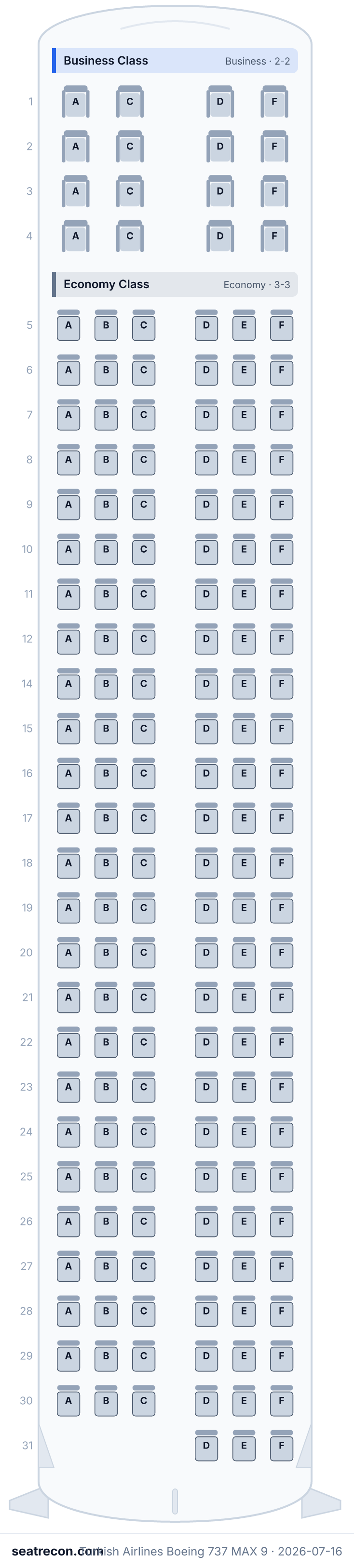
- This configuration has 169 seats: 16 Business Class, 153 Economy Class.
- What are the best seats on the Turkish Airlines Boeing 737 MAX 9?
- No standout seat is established by the available evidence for this layout. Unresolved comfort details remain unverified.
- Which seats should I avoid?
- No seats on this layout are flagged as ones to avoid.
- Does the Turkish Airlines Boeing 737 MAX 9 have lie-flat seats?
- No — this configuration has no lie-flat seats.
Cabins
Business Class
- Seat
- Recliner
Economy Class
- Seat
- Standard seat
Seat map image
A printable snapshot of this exact layout — save it for boarding-day reference. The interactive map above stays the source of truth.
Sources
Every measurement and claim on this page traces back to one of these. Last verified Jul 16, 2026.
- Turkish AirlinesPRIMARY SOURCERetrieved Jul 16, 2026
Official fleet catalog identifies the Boeing 737 MAX 9 as a Turkish Airlines fleet type.
The live endpoint stalled during raw retrieval, so the snapshot is a decoded Wayback raw-bytes capture (2026-01-13). It confirms the type in the airline fleet catalog but does not publish fleet count, cabin counts, dimensions, row numbers, seat letters or a seat map.
https://www.turkishairlines.com/en-gb/flights/fly-different/fleet/ ↗ - Turkish AirlinesPRIMARY SOURCERetrieved Jul 16, 2026
Official former Boeing 737 MAX 9 specification page publishes a passenger capacity of 169.
The snapshot is the latest available Wayback raw-bytes capture (2020-05-08). It proves the operator-published 169-seat capacity but not current fleet status, the Business/Economy split, abreast layouts, row numbering or a seat map.
https://www.turkishairlines.com/en-int/flights/fly-different/boeing-B737-9max-narrow-body/ ↗ - WikipediaINDEPENDENT SOURCERetrieved Jul 14, 2026
Current-fleet table (as of June 2026): Turkish Airlines operates five Boeing 737 MAX 9s in one listed 16 Business / 153 Economy = 169 configuration.
Neutral compilation used for current status, fleet count and the single listed cabin split only. It does not publish a row map, seat letters, dimensions or the geometry of the three-seat count remainder.
https://en.wikipedia.org/wiki/Turkish_Airlines_fleet ↗ - Turkish AirlinesPRIMARY SOURCERetrieved Sep 30, 2026
Current official fleet catalogue lists this aircraft model; it does not identify numbered layouts or each cabin-count variant.
2026-09-30 audit verified model listing only. The existing seat grid remains derived from prior cabin totals: rows, letters, partial rows and cabin boundaries are not verified against a numbered official map. Current subfleet split, hardware, measurements and operation of this exact capacity remain unresolved; lastVerifiedAt is retained.
https://www.turkishairlines.com/en-int/flights/fly-different/fleet/ ↗ - Turkish AirlinesPRIMARY SOURCERetrieved Sep 30, 2026
Current official model specification page reviewed; generic type descriptions do not prove the individual configuration cabin split or layout.
2026-09-30 audit verified model listing only. The existing seat grid remains derived from prior cabin totals: rows, letters, partial rows and cabin boundaries are not verified against a numbered official map. Current subfleet split, hardware, measurements and operation of this exact capacity remain unresolved; lastVerifiedAt is retained.
https://www.turkishairlines.com/en-int/flights/fly-different/fleet/boeing-737-max-9/ ↗
Turkish Airlines' former official MAX 9 specification publishes 169 passengers; the June 2026 current-fleet table assigns the type 16 Business / 153 Economy = 169 across five aircraft, with no second MAX 9 configuration listed. No permitted source located publishes an exact Turkish MAX 9 row map. The grid is therefore DERIVED: 4 modeled conventional 2-2 Business rows (4 x 4 = 16) at rows 1-4, followed by 25 modeled full 3-3 Economy rows (25 x 6 = 150) plus a modeled final three-seat half-row, totaling 153 Economy seats. Economy is represented at rows 5-31 with row 13 omitted solely as the TK narrowbody corpus numbering convention; the final remainder is placed at 31D-F solely for count reconciliation and to match the parallel TK MAX 8 representational convention. All row numbers, seat letters, cabin boundary, abreast layouts and partial-row placement are modeling inferences rather than Turkish-published seat assignments. The Business recliner category is inferred from the modeled conventional 2-2 narrowbody premium cabin. No variant-exact 737 MAX 9 engineering window grid exists in data/window-grids, so aircraft.windowGridType is intentionally omitted rather than binding the shorter MAX 8 or differently engineered 737-900ER grid; all window-seat alignments remain unknown. Monuments, exit rows, wing limits, bassinets, preferred zones, amenities, IFE, seat dimensions, hardware models, registrations and per-tail variation are intentionally not asserted. 2026-09-30 audit verified model listing only. The existing seat grid remains derived from prior cabin totals: rows, letters, partial rows and cabin boundaries are not verified against a numbered official map. Current subfleet split, hardware, measurements and operation of this exact capacity remain unresolved; lastVerifiedAt is retained.
What changed
- Sep 30, 2026Archived current primary fleet/type evidence; preserved prior derived geometry, status and verification date because exact current numbered map and configuration coverage remain unresolved.
- Jul 16, 2026Initial Turkish Airlines 737 MAX 9 16J/153Y = 169 configuration; cabin totals sourced and row geometry explicitly derived.