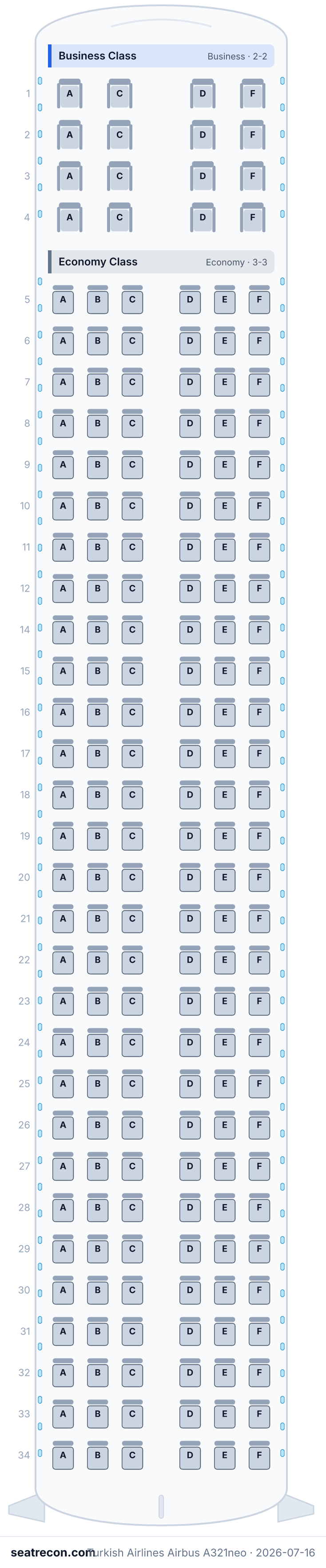
Turkish Airlines Airbus A321neo seat map — 190 seats
Seat map
Hover or tap any seat to see its rating and details.
Tap or hover a seat for its rating and details. On a phone, pinch to zoom and drag to pan.
Tap a seat number to jump to it on the map.
How we rate seats →Seat guide
Cabin-by-cabin guidance generated from the verified layout records behind this map — which seats the ratings favor, which to think twice about, and the rows worth knowing about before you pick.
Business Class
Ratings are even across this cabin — no standout or problem seats in our records.
Economy Class
Ratings are even across this cabin — no standout or problem seats in our records.
Frequently asked questions
- How many seats does the Turkish Airlines Airbus A321neo have?
- This configuration has 190 seats: 16 Business Class, 174 Economy Class.
- What are the best seats on the Turkish Airlines Airbus A321neo?
- No standout seat is established by the available evidence for this layout. Unresolved comfort details remain unverified.
- Which seats should I avoid?
- No seats on this layout are flagged as ones to avoid.
- Does the Turkish Airlines Airbus A321neo have lie-flat seats?
- No — this configuration has no lie-flat seats.
Cabins
Business Class
- Seat
- Recliner
- Screen
- 13"
Economy Class
- Seat
- Standard seat
- Screen
- 12"
Amenities
Seat map image
A printable snapshot of this exact layout — save it for boarding-day reference. The interactive map above stays the source of truth.
Sources
Every measurement and claim on this page traces back to one of these. Last verified Jul 16, 2026.
- Turkish AirlinesPRIMARY SOURCERetrieved Jul 16, 2026
Official A321neo fleet page: the aircraft joined the Turkish Airlines fleet in 2018 and provides 13-inch high-resolution Business Class screens, 12-inch Economy Class touchscreens, in-flight Wi-Fi and customizable cabin lighting.
The live endpoint timed out, so the snapshot is the latest available Wayback raw-bytes capture (2023-11-30). The page describes the type generically and does not publish cabin counts, abreast layouts, row numbers, seat letters, dimensions or a seat map.
https://www.turkishairlines.com/en-int/flights/fly-different/fleet/airbus-a321neo/ ↗ - WikipediaINDEPENDENT SOURCERetrieved Jul 14, 2026
Current-fleet table (updated June 2026): Turkish Airlines operates 58 A321neos and lists two passenger configurations, 20 Business / 162 Economy = 182 and 16 Business / 174 Economy = 190.
Neutral compilation used for current configuration scope and cabin totals only. It does not publish row maps or allocate the 58-aircraft fleet total between configurations.
https://en.wikipedia.org/wiki/Turkish_Airlines_fleet ↗ - Planespotters.netINDEPENDENT SOURCERetrieved Jul 16, 2026
Current production-list search results identify active Turkish Airlines A321neo airframes in both C20Y162 and C16Y174 configurations, confirming that both configurations are currently flying.
Planespotters returned HTTP 403 when fetched directly. This claim is limited to current search-index result snippets retrieved on 2026-07-16, so no source snapshot is available; it establishes active configuration scope, not row geometry.
https://www.planespotters.net/aircraft/search?dir=desc&fleet=Turkish-Airlines&fleetStatus=current&sort=reg ↗ - Turkish AirlinesPRIMARY SOURCERetrieved Sep 30, 2026
Current official fleet catalogue lists this aircraft model; it does not identify numbered layouts or each cabin-count variant.
2026-09-30 audit verified model listing only. The existing seat grid remains derived from prior cabin totals: rows, letters, partial rows and cabin boundaries are not verified against a numbered official map. Current subfleet split, hardware, measurements and operation of this exact capacity remain unresolved; lastVerifiedAt is retained.
https://www.turkishairlines.com/en-int/flights/fly-different/fleet/ ↗ - Turkish AirlinesPRIMARY SOURCERetrieved Sep 30, 2026
Current official model specification page reviewed; generic type descriptions do not prove the individual configuration cabin split or layout.
2026-09-30 audit verified model listing only. The existing seat grid remains derived from prior cabin totals: rows, letters, partial rows and cabin boundaries are not verified against a numbered official map. Current subfleet split, hardware, measurements and operation of this exact capacity remain unresolved; lastVerifiedAt is retained.
https://www.turkishairlines.com/en-int/flights/fly-different/fleet/airbus-a321neo/ ↗
The current-fleet source lists a second Turkish Airlines A321neo configuration of 16 Business / 174 Economy = 190, and current neutral airframe tracking identifies active C16Y174 aircraft without archived delivery chronology. Turkish Airlines' fleet page confirms the shared A321neo cabin product and amenities but does not publish counts or a seat map. No permitted source located publishes an exact Turkish row map. The grid is therefore DERIVED: 4 conventional 2-2 Business rows (4 x 4 = 16) at modeled rows 1-4, followed by 29 conventional 3-3 Economy rows (29 x 6 = 174) at modeled rows 5-34 with row 13 omitted solely as a representational convention. All row numbers, seat letters, cabin boundaries and abreast layouts are modeling inferences rather than Turkish-published seat assignments. The aircraft.windowGridType binding uses SeatRecon's variant-exact A321neo ACF engineering grid, but all exact window alignments remain unknown because the row grid is derived. Monuments, exit-row placement, wing limits, bassinets, paid-seat zones, power, hardware dimensions and per-tail variation are intentionally not asserted. The archived fleet table supports this higher-density capacity variant without delivery chronology; it does not establish a retrofit relationship with the 182-seat subfleet, so no replaces/supersededBy link is asserted. 2026-09-30 audit verified model listing only. The existing seat grid remains derived from prior cabin totals: rows, letters, partial rows and cabin boundaries are not verified against a numbered official map. Current subfleet split, hardware, measurements and operation of this exact capacity remain unresolved; lastVerifiedAt is retained.
What changed
- Oct 1, 2026Independent primary-source follow-up: correct source-specific product, provenance and furniture claims; retain unresolved layout uncertainty.
- Sep 30, 2026Archived current primary fleet/type evidence; preserved prior derived geometry, status and verification date because exact current numbered map and configuration coverage remain unresolved.
- Jul 16, 2026Initial Turkish Airlines A321neo 16J/174Y = 190 configuration; cabin totals sourced and row geometry explicitly derived.