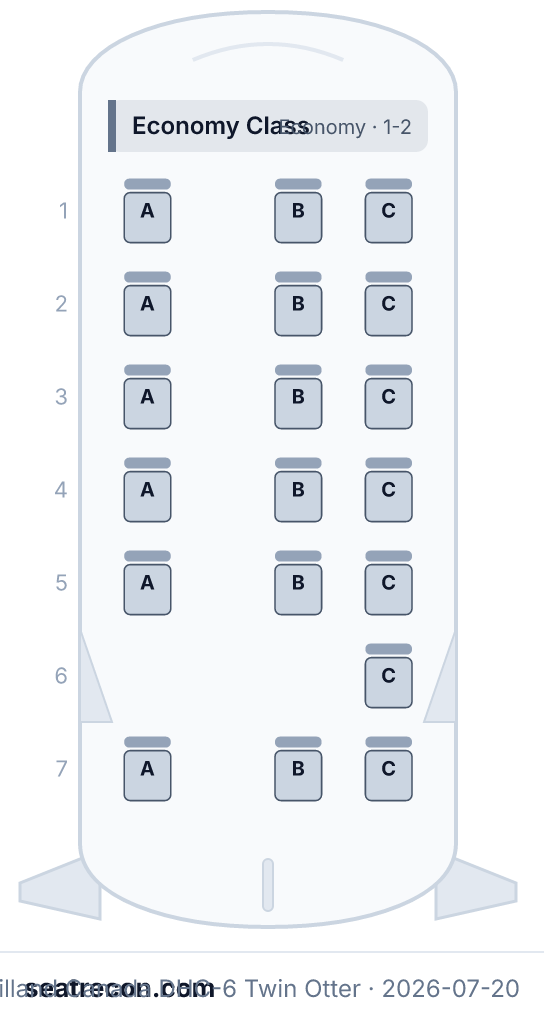
Fiji Link De Havilland Canada DHC-6 Twin Otter seat map
Seat map
Hover or tap any seat to see its rating and details.
Tap or hover a seat for its rating and details. On a phone, pinch to zoom and drag to pan.
Tap a seat number to jump to it on the map.
How we rate seats →Seat guide
Cabin-by-cabin guidance generated from the verified layout records behind this map — which seats the ratings favor, which to think twice about, and the rows worth knowing about before you pick.
Economy Class
Ratings are even across this cabin — no standout or problem seats in our records.
Frequently asked questions
- How many seats does the Fiji Link De Havilland Canada DHC-6 Twin Otter have?
- This configuration has 19 seats: 19 Economy Class.
- What are the best seats on the Fiji Link De Havilland Canada DHC-6 Twin Otter?
- No seat on this layout earns a standout rating — comfort is even across rows.
- Which seats should I avoid?
- No seats on this layout are flagged as ones to avoid.
- Does the Fiji Link De Havilland Canada DHC-6 Twin Otter have lie-flat seats?
- No — this configuration has no lie-flat seats.
Cabins
Economy Class
- Seat
- Standard seat
Seat map image
A printable snapshot of this exact layout — save it for boarding-day reference. The interactive map above stays the source of truth.
Sources
Every measurement and claim on this page traces back to one of these. Last verified Jul 20, 2026.
- Fiji AirwaysPRIMARY SOURCERetrieved Jul 20, 2026
The current official Fiji Link Twin Otters page identifies the DHC-6 Series 400, publishes 19 all-Economy leather seats, and shows five 1-2 positions followed by one single seat and a three-seat rear bench.
The diagram has no row numbers or seat letters. Direct raw retrieval failed and browser policy blocked image download, so the snapshot is rendered text plus a conservative diagram transcription, not the original image bytes.
https://www.fijiairways.com/en-us/book/our-fleet/Twin-Otters ↗ - Fiji Airways / Parliament of FijiPRIMARY SOURCERetrieved Jul 20, 2026
Fiji Airways' Annual Report 2024 page 23 publishes four DHC-6-400 aircraft with 19 Economy seats each.
Year-end 2024 fleet evidence; current neutral corroboration is used for the July 2026 fleetCount.
https://www.parliament.gov.fj/wp-content/uploads/2026/03/11Fiji-Airways-Annual-Report-2024-2.pdf ↗ - WikipediaINDEPENDENT SOURCERetrieved Jul 20, 2026
The current neutral article identifies Fiji Link as the trade name of Fiji Airlines Limited, publishes passenger code FJ and ICAO FJA, and lists ATR 42-600, ATR 72-600, and DHC-6-400 as current fleet types.
Used for operator identity, codes, and fleet-type corroboration only. Its ATR 72 cabin cells are internally inconsistent, so configuration counts and grids come from Fiji Airways primary sources.
https://en.wikipedia.org/api/rest_v1/page/html/Fiji_Link ↗
IDENTITY / ID: Fiji Link is the operating brand (ICAO FJA) but uses the shared FJ passenger code. The collision-safe fjlink-* namespace is a stable operator token because Fiji Airways mainline already occupies fj-*; airline.iata remains FJ. Code 19Y is a SeatRecon capacity discriminator. CURRENT CONFIGURATION: the live Twin Otters page identifies DHC-6 Series 400 aircraft, publishes 19 all-Economy leather seats, and shows five ordinary 1-2 positions (15 seats), one following single seat on the two-seat side, and a three-seat rear bench. This Fiji diagram differs from the Loganair exemplar and is not cloned from it. MIXED GRID: the diagram prints no row numbers or seat letters. SeatRecon represents the ordinary positions as rows 1-5 A/B-C, the next single as 6C, and the rear bench as row 7 A/B/C with 7B position-overridden to middle. These identifiers and side mapping are conventions; every row and the cabin are derived. geometryHint is other because the rear bench crosses the ordinary aisle geometry. Current neutral evidence and the 2024 report both list four DHC-6-400s, so fleetCount is four. The diagram depicts exits but provides no row labels; no exits, furniture, wing range, pitch, width, recline limitation, amenities, or seat-specific advantages/drawbacks are inferred. No DHC-6 window grid exists; windowGridType is omitted and window-seat alignment remains unknown.
What changed
- Jul 20, 2026Initial active Fiji Link DHC-6-400 Twin Otter (19 seats, all Economy) configuration from current first-party fleet pages and permitted neutral corroboration.